What to do if the main switch is simply OFF
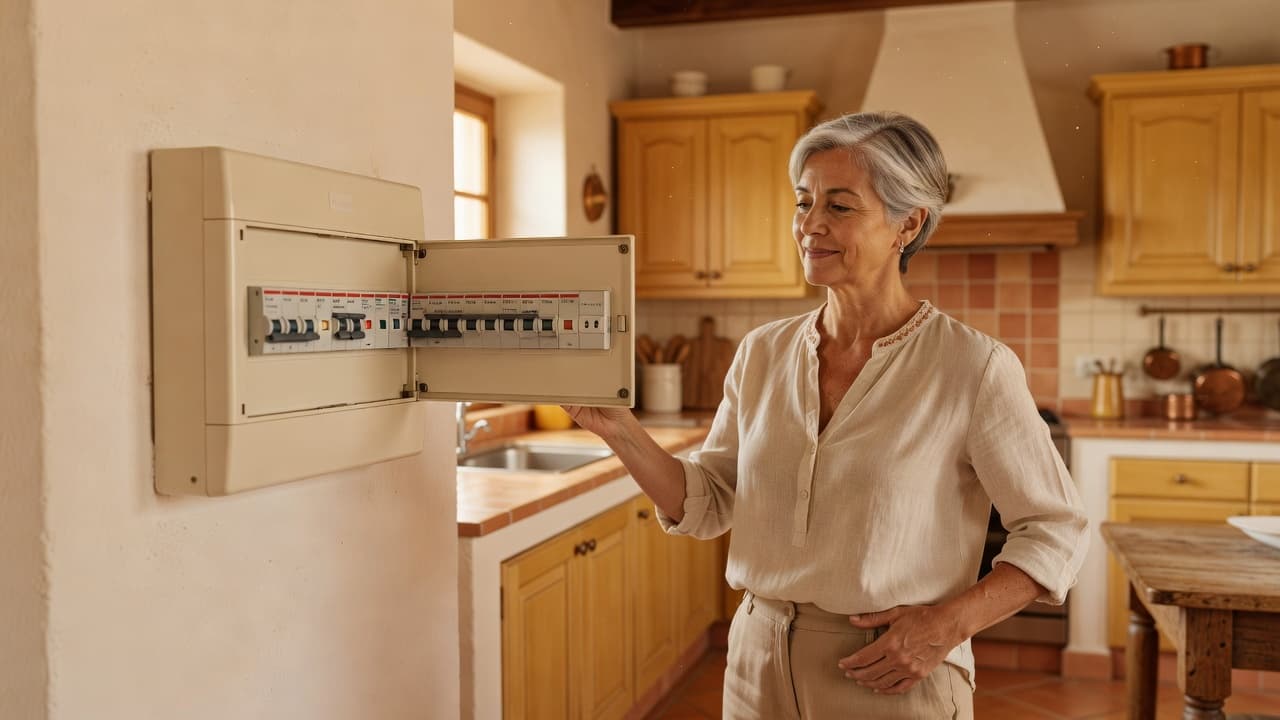
If the main switch or main circuit breaker is clearly in the OFF position and you see no signs of burning or damage, it's safe to switch it back ON.
Step 1: Switch the main switch fully to the ON position. It may click firmly into place.
Step 2: Go back into your home. Do the lights come on? Do your sockets work again?
Step 3: If power has been restored, your problem is solved. Monitor the situation over the next few hours to check if everything stays on. If it trips again within a few minutes, see the "When NOT to try fixing it yourself" section below.
If the RCD (the red lever) is in the OFF position, switch that back to ON first, before touching the main breaker.
If only one room or one set of sockets has no power, you're dealing with a single circuit breaker, not the main one. Look inside the consumer unit for a smaller switch that is in the OFF position or appears different from the others (sometimes they're positioned at a slight angle if tripped).
Flip that switch back to ON. Check if power returns to that room or socket. Done.
If it trips immediately, or if you can't identify which switch controls which area, stop and call an electrician. Your circuit has a fault that needs professional diagnosis.
Why your main switch has tripped
A circuit breaker trips — or a main switch gets switched off — when it detects a fault or overload to protect your home from electrical fire or damage. Common reasons include:
Overload. You've plugged in too many high-power appliances at once (air conditioning unit, electric heater, washing machine, oven all running simultaneously). The system has cut power to prevent overheating.
A fault in an appliance. One of your devices has a short circuit or damage, and the safety system has disconnected it.
Damage to a socket or switch. A switch or socket in your home has failed or been damaged, perhaps by age, humidity (common in coastal properties), or salt air corrosion.
A problem with the incoming supply. In rare cases, the issue is with the connection from the street to your home, not inside your property. This is the electricity company's responsibility.
Moisture in the consumer unit. In humid coastal properties, moisture can trigger the RCD. This is especially common in bathrooms or near the sea.
If your power is out and you need to restore basic function quickly, here's what's actually safe to do:
Reset the main switch once. If it's OFF, switch it ON. If it trips again within a few minutes, don't reset it again — call an electrician. Repeated tripping means there's an active fault.
Unplug any appliances you were using before the blackout. If the power cut happened whilst you were using the oven, washing machine, or air conditioning, unplug it. Wait 10 minutes. Then reset the main switch. If it stays on, the problem was that appliance. You can use everything else safely whilst you arrange for that device to be inspected.
Dry out the consumer unit if you suspect moisture. If you live in a very humid coastal property and the RCD keeps tripping even with no appliances running, open the consumer unit door and let it air for 30 minutes. Sometimes condensation from coastal humidity triggers false trips. Do not attempt to clean or dry the internal components — just allow air circulation.
Switch off circuits you don't need immediately. If the main switch stays on but you suspect a fault in one room, you can switch off the circuit breaker for that room and use the rest of your home normally. This is safe and buys you time until an electrician arrives.
These are the only safe temporary actions. Everything else requires a professional.
Stop immediately and call an electrician if:
- You see scorch marks, burn marks, or discolouration inside the consumer unit or around any switch.
- You smell burning or a chemical smell near the consumer unit or anywhere in your home.
- You hear a buzzing, crackling, or hissing sound from the consumer unit or from any socket.
- The main switch is stuck and won't move, or it's hard to move and you have to force it.
- The power trips again within 5–10 minutes of you resetting it. This indicates an active fault that needs diagnosis.
- You are unsure which switch does what, or the labelling inside the unit is missing or illegible. Guessing can be dangerous.
- You see water or moisture inside the consumer unit (not just humidity, but actual water pooling). This is a serious hazard.
- The RCD (the safety breaker) keeps tripping even when no appliances are plugged in. This usually means a fault in the main circuit that needs professional investigation.
- You are at all uncertain about what you're looking at. If the consumer unit looks different from the description here, or you don't recognise the components, don't touch it.
In any of these cases, switch off the main switch and do not switch it back on. Call an electrician and describe what you saw. If you live in an urbanisation (a gated community or apartment block), you may also need to inform the community manager (administrador).
When you call a qualified electrician to investigate a loss of power, they will:
Test and diagnose. They'll check that your neighbours genuinely have power (to rule out a street fault), then use a multimeter to test the voltage at your consumer unit and in your circuits. They'll trace which circuit or component has failed.
Inspect the consumer unit and incoming connection. They'll examine the main switch, the RCD, the individual circuit breakers, and the cable coming in from the street. They'll look for signs of damage, age, corrosion, or moisture.
Test individual appliances and circuits. If they suspect a faulty appliance caused the trip, they'll isolate and test it to confirm.
Make the repair or issue a recommendation. If it's a simple fix — a tripped breaker, a loose connection, or a faulty individual circuit breaker — they'll fix it and test that everything works. If the issue is more serious (damage to the consumer unit, a fault in the incoming supply, or a faulty appliance), they'll explain what needs to happen next and may refer you to the electricity company or recommend you replace the consumer unit.
Provide documentation. If your consumer unit is old or has been repaired, ask the electrician for a certificate or a report. In Spain, if major electrical work is done, a boletín eléctrico (electrical installation certificate) may be required. This is important for your insurance and if you ever sell the property.
Don't overload your circuits. If you're in a holiday home or using multiple high-power appliances in summer, avoid running your air conditioning, electric heater, oven, and washing machine simultaneously. Stagger their use.
Check appliances that trip the power regularly. If the same appliance always causes the blackout, it's faulty and needs replacement or repair. Don't keep resetting the power and hoping it will work — it won't get better on its own.
Keep the consumer unit clear and dry. Don't store things in front of it or directly against the wall where it's mounted. Ensure air can circulate around it. In coastal properties, check it occasionally for signs of corrosion or moisture.
Have a professional inspection if your home is old. If you've bought a property with an elderly consumer unit, or if electrical faults are becoming frequent, ask an electrician for a full inspection. Your insurance may require this anyway.
Know where your main switch is. In an emergency (fire risk, smell of burning), you should be able to find and switch off the main power. It's worth identifying it now, whilst there's no emergency.
If your power is still out after checking these steps, or if you've spotted any of the warning signs above, contact a qualified electrician as soon as possible. Electrical faults are not something to leave unattended — they're a fire and safety risk.