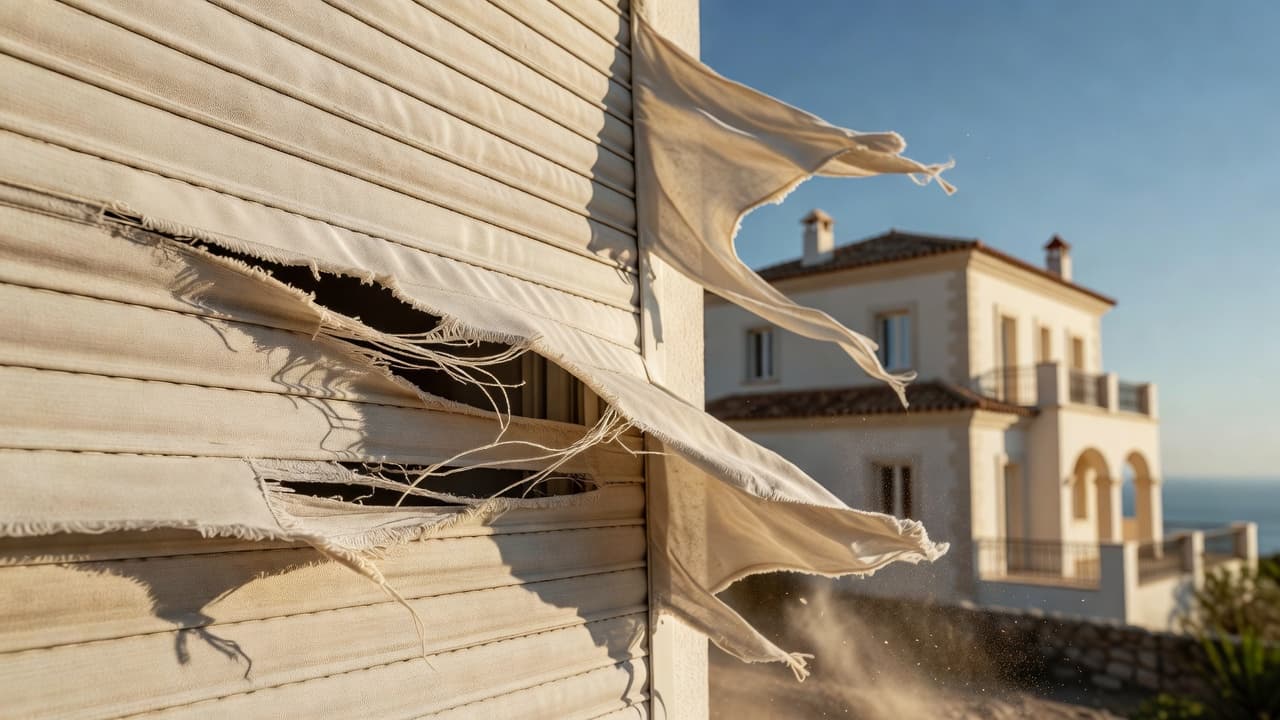
The levante wind on Spain's Mediterranean coast is not a gentle breeze. It's a powerful, sustained gust that can exceed 50–60 km/h in spring and autumn. When outdoor curtains or roller blinds are open or partially open, the wind treats them as a sail. It catches the fabric and exerts force on the mounting brackets.
For fabric curtains, this can tear the material, especially if it's thin or already weakened by salt spray and UV exposure. For roller blinds, the sudden force can twist the frame or damage the rollers and guide rails. Mounting brackets—usually cheap aluminium or plastic—can bend or even pull away from the wall.
The damage is worse if:
- The curtains are made of lighter fabric that doesn't resist wind well.
- They're mounted to a poorly built frame or loose brackets.
- The installation is old and the fabric has already weakened from sun and salt air.
- Your property is in an exposed location (on a hill, facing the sea, or in an open development).
Do not try to repair or replace the full installation yourself. But here's what you can safely do to prevent the damage from getting worse:
Small tears in the fabric:
If the tear is less than 10 cm long and doesn't involve the stitching that holds the fabric to the roller, you can make a temporary repair. Cut a patch from similar fabric or buy a repair patch kit (available online). Using fabric glue or needle and thread, apply the patch over the tear on the underside of the fabric. This won't be permanent, but it stops the tear spreading. Once the curtains are fully closed, this repair holds until a professional replaces the material.
Flapping or loose fabric:
If the fabric is torn and hanging loose, bundle it carefully to the frame using rope or soft cable ties. Don't use duct tape directly on delicate outdoor fabrics—it's hard to remove and leaves residue. Instead, use rope looped around the fabric and frame, or bind the loose edges to the sides of the frame. This keeps the fabric from catching and tearing further.
Bent or misaligned frames:
Do not try to bend the frame back yourself. Metal frames are under tension, and forcing them can crack welds or cause the entire installation to collapse. Leave it closed and call a handyman. If it's severely bent and dangerous, take the curtains down entirely (see below).
Removing the curtains temporarily:
If the damage is severe and you're worried the installation might fail, unscrew the mounting brackets and take the curtains down. This is safe if you use a step ladder and take your time. Get someone to help you support the weight. Once down, store the installation in a garage or lean-to out of the wind. This is a good temporary fix while you arrange for professional repair or replacement.
Do not attempt to repair the installation if:
- The frame is badly bent, cracked, or misaligned. Trying to straighten metal under tension is dangerous. A misaligned frame can collapse suddenly.
- The mounting brackets are loose, bent, or pulling away from the wall. This is a structural safety issue. The curtains could fall and injure someone below.
- The rollers are damaged, cracked, or not turning freely. Don't force them. The roller is under spring tension, and forcing it can snap the spring or cause sudden release.
- The curtains are electrical or motorised. Do not attempt any repairs. There's a risk of electrocution. Wait for a professional electrician or handyman trained in the system.
- The fabric is torn extensively (more than 50 cm of rips) or the stitching is compromised. This requires professional replacement, not patching.
- You're not confident on a step ladder or working at height. Outdoor curtains are often mounted 3–4 metres up. If you're uncomfortable, don't do it. Fall risk is real, especially in wind.
If any of these apply, close the curtains, bundle any loose fabric, and contact a handyman. Do not attempt further work.
A handyman will start by fully inspecting the installation. They'll check:
- The fabric for tears, weak seams, or sun damage.
- The roller mechanism (if it's a roller blind) for cracks, bent tubes, or damaged bearings.
- The mounting brackets for bending, corrosion, or loose fasteners.
- The guides and frame for misalignment or cracks.
If the fabric is torn but the frame is sound, the handyman can replace just the fabric. This is cheaper than a full replacement and usually takes a few days. They'll remove the old material, fit new fabric to the roller (if it's a roller blind) or to the frame (if it's a hanging curtain), and re-tension it properly.
If the frame is bent or the rollers are damaged, replacement is necessary. The handyman will measure the opening, order a new unit (usually ready in 5–10 days), and install it. This is more expensive, but the result is a fully functional system that can handle future levante wind.
If the brackets are loose or bent, the handyman will remove the installation, repair or replace the brackets, and reinstall the curtains. They'll also check the wall for damage and make sure new fixings are secure.
Once the work is done, the professional will test the curtains to ensure they open and close smoothly, lock properly, and are secure. They'll also advise you on maintenance and proper use during high wind.
- Always close your outdoor curtains fully before high wind. The levante doesn't arrive without warning. Keep an eye on the weather forecast and retract them when wind speeds exceed 40 km/h.
- Maintain the installation. Check mounting brackets once a year for rust or loosening. If you see corrosion (common near the coast), have a handyman tighten or replace brackets.
- Replace sun-damaged fabric before wind season. If your curtains are over 5–7 years old and exposed to strong sun, the fabric weakens. Replace it before spring and autumn winds arrive.
- Invest in a quality installation from the start. Cheap brackets and thin fabric are a false economy on the Mediterranean coast. A robust installation costs more but survives levante and salt air.
- Consider motorised curtains with wind sensors. Some modern roller blinds have wind sensors that close automatically when gusts exceed a threshold. These are more expensive upfront but save repeated damage.
If your outdoor curtains have been damaged by the levante or another wind event, don't attempt a complex repair. Find a reliable handyman in your area who specialises in exterior installations. They'll assess the damage, tell you honestly whether repair or replacement makes sense, and get your curtains secure and functional again within days.