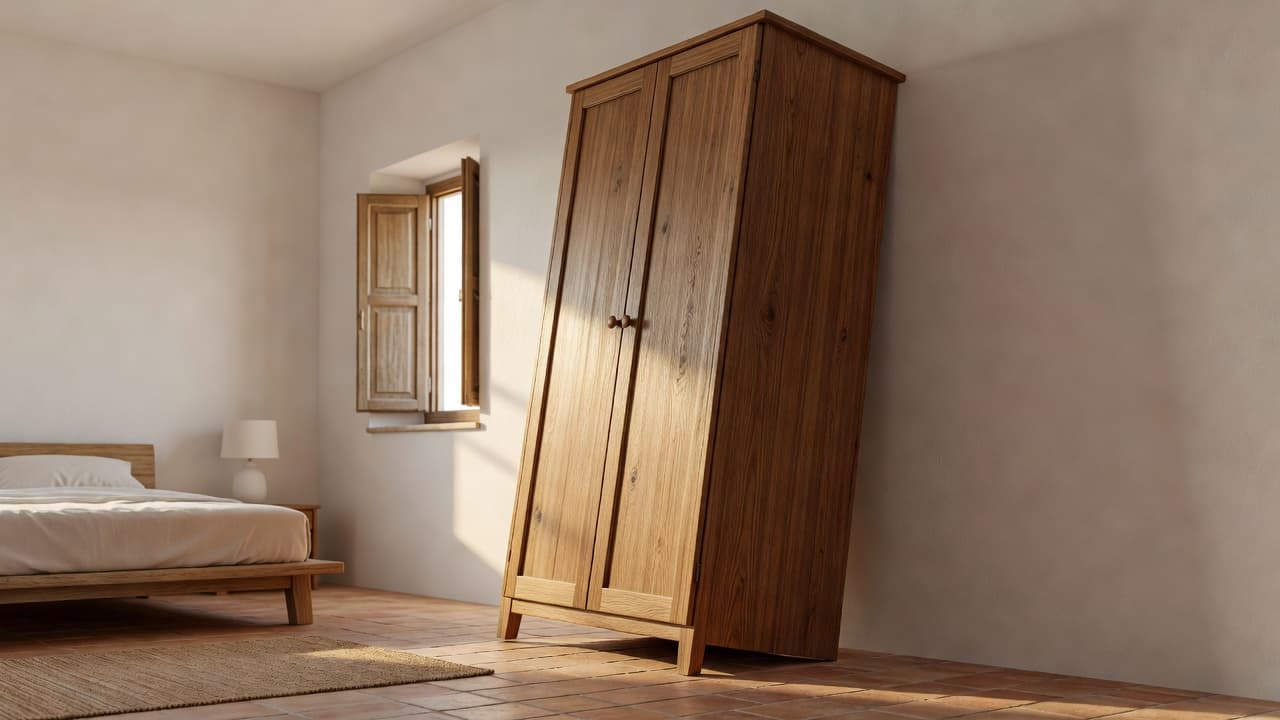
Most heavy wardrobes tip for one of three reasons:
Uneven floor. Spanish properties—especially flats on the coast—often have floors that are slightly sloped or uneven. This is normal, but it means furniture won't sit level without adjustment. The wardrobe tilts forward because the back feet are resting lower than the front feet.
Shallow depth. Modern wardrobes are often shallower than older models. They have a higher centre of gravity. If the floor is slightly uneven, even a small slope will cause the wardrobe to feel unstable.
No wall anchors. Most wardrobes are delivered without being secured to the wall. In showrooms and homes in the UK, this is often acceptable because floors are level. Here on the coast, with older properties and variable flooring, it's a risk.
You need to anchor the wardrobe to the wall. This is not difficult, but it must be done correctly.
First, make sure the wardrobe is actually level and standing on all four feet (or three, if it's a three-legged design).
- Place a spirit level (a torpedo level, about 60 cm long) on top of the wardrobe, running front to back.
- If the bubble is not in the centre, the wardrobe is tilted.
- Slightly raise the front feet by sliding thin shims (wooden wedges, or even coins stacked under the feet) under the front feet until the wardrobe is level.
- Do not over-tighten or force the feet—just adjust until the spirit level shows level.
- Check that all feet are now in firm contact with the floor. There should be no rocking.
You need to secure the wardrobe to the wall with at least two heavy-duty brackets, ideally three or four (especially if the wardrobe is tall—over 1.8 metres—or very heavy).
If your walls have studs (wooden framing): You're in luck. Use coach bolts or lag bolts rated for at least 50 kg each. Screw them into the studs through the back panel of the wardrobe, or use heavy-duty L-brackets bolted to the studs.
If your walls are plasterboard without studs (common in Spanish flats): You'll need cavity wall anchors. The best options are:
- Toggle anchors (mariposa): rated 20–40 kg each, depending on the quality and wall thickness.
- Expansion anchors (taco de expansión): plastic wall plugs rated for 30–60 kg, depending on size.
Buy anchors rated for at least 30–40 kg each. If the wardrobe weighs 50 kg, use at least two anchors. If it weighs 70 kg or more, use three or four.
- Measure up from the top of the wardrobe to about 30 cm down (or slightly higher if the wardrobe is very tall).
- Mark two or three points on the wall at the same height, spaced evenly across the width of the wardrobe.
- Use a spirit level to make sure the marks are horizontal.
- Drill holes at your marked points. Use a drill bit the same diameter as your wall anchor.
- Insert the wall anchors according to the product instructions. Most cavity anchors require you to push them in, then screw a bolt through them until they expand behind the plasterboard.
- Do not over-tighten. The anchor should be firm, not forced.
- Position heavy-duty L-brackets or angle brackets on the back panel of the wardrobe, aligned with your newly installed wall anchors.
- Bolt the brackets to the wardrobe (usually two bolts per bracket) and to the wall anchors.
- Tighten firmly, but again, do not force. The goal is a snug, immovable fit, not maximum force.
- Gently push on the top of the wardrobe from the side. It should not move at all. If it rocks or flexes, tighten the brackets further or add another anchor.
- Open the doors slowly. The wardrobe should remain stable.
- Once secure, the wardrobe can be used normally.
Call a professional if:
- The wardrobe is extremely heavy (you struggle to move it at all by yourself) and your walls are poor quality (crumbling plaster, thin plasterboard, visible cracks). An incorrectly anchored heavy wardrobe is worse than an unanchored one.
- The back panel of the wardrobe is damaged, soft, or shows signs of water damage or woodworm. The anchors won't hold if the wood is compromised.
- You don't have access to the tools needed (power drill, spirit level, appropriate wall anchors and brackets). It's worth paying a handyman for a job done safely rather than improvising.
- The wardrobe is rented or belongs to a property you don't own. Contact the landlord or property manager immediately. They are responsible for ensuring furniture is safe, and they may have specific instructions for securing it.
- There are cracks in the wall around the wardrobe, or the wall itself feels unstable or damp. This suggests a structural issue that needs investigation before you secure anything to it.
If you decide to hire a handyman to secure the wardrobe, here's what a competent one will do:
They'll first assess the stability of the wardrobe and the condition of the wall. They'll check for studs using a stud finder, and they'll test the wall's load-bearing capacity. If the wall is weak or damaged, they'll advise you before proceeding.
They'll level the wardrobe properly and install anchors rated for the wardrobe's weight. A good handyman will use more anchors than the minimum, because Mediterranean homes often have variable conditions. They'll test the installation by applying reasonable lateral force to the wardrobe before finishing.
They'll usually provide a simple record of what was done—not a formal certificate, but a note of the anchor type, number, and location, in case you need it later (for insurance, or if you move house).
The whole job typically takes 45 minutes to an hour.
- Check wardrobes and tall furniture regularly. Once a year, gently test any heavy wardrobe or tall cabinet to see if it still feels stable. Mediterranean homes shift slightly with temperature and humidity changes, so anchors can loosen over time.
- Avoid overloading the top. Don't pile heavy boxes or decorative items on top of the wardrobe. This raises the centre of gravity and makes tipping more likely.
- Use the doors gently. Don't hang on the doors or open them with force. This applies stress to the hinges and frame, and can contribute to instability over time.
- If you move the wardrobe, re-secure it immediately in its new location. Never assume anchors from one location will work in another—the wall may be different, and the angle of the wardrobe may have changed.
A tipping wardrobe is a nuisance you can fix in an afternoon, and a safety issue you must fix today. If you're unsure about any step, or if the wardrobe is very heavy or your walls are in poor condition, don't hesitate to call a local handyman. What matters is that it's secure and stable by tonight.
If you need help, our experienced handymen on the coast can level and secure the wardrobe safely, and quickly. Get a quote today.