Door banging usually happens for one of three reasons.
The door swings freely. Older doors, or doors with worn hinges, swing easily when opened. A coastal breeze, a draught from opening windows, or vibration from passing traffic can push the door open further than intended, and it hits the wall.
The wall is too close. Some homes — especially flats in Spanish urbanisations — have narrow hallways where the door simply doesn't have enough space to open fully without hitting the wall.
The door is heavier than the stops. Heavy wooden doors, especially exterior doors or older solid-wood interior doors, have more momentum. A lightweight rubber wedge stopper may not hold them, and they'll push past it.
In any of these cases, the solution is either a properly sized stopper (heavier or wall-mounted for security) or, occasionally, adjusting the door's swing (which a handyman can do, but is beyond this guide).
For a wedge-style rubber stopper (easiest option):
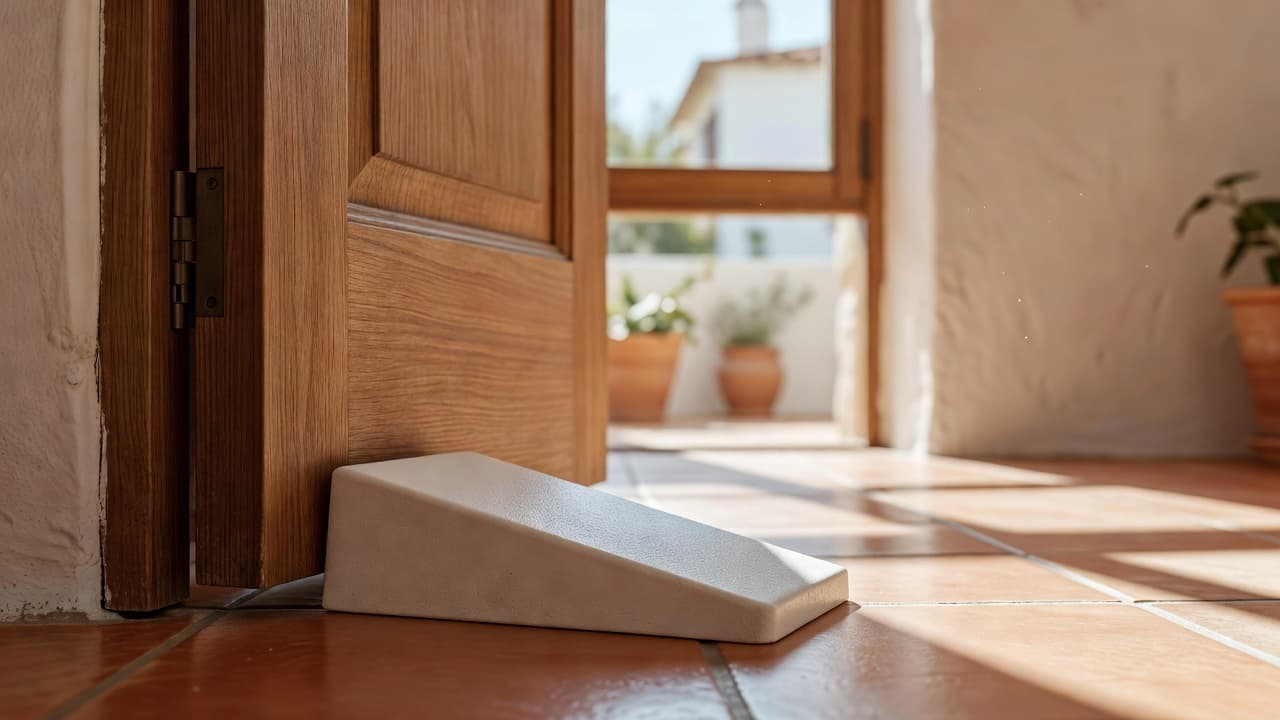
This is the quickest fix. Buy a rubber doorstop wedge from any hardware shop — they cost a few euros and come in standard sizes. Place it on the floor directly under the open door, just before where the door would strike the wall. The door swings open, hits the rubber wedge, and stops. No tools, no fitting, no mess.
The downside: if the door is heavy or the floor is sloped (common in older Spanish homes), the wedge can slide around. You'll need to reposition it occasionally.
For a wall-mounted rubber bumper (more permanent):
This is still simple, but requires a drill and three screws.
Mark the spot. Open the door fully and look at where the door frame or handle comes closest to the wall. Measure the height from the floor (usually 70–100 centimetres, depending on door height and handle position). Mark the wall with a pencil at this height.
Check what's behind the wall. Tap the wall with your knuckles. If it sounds hollow, it's drywall or plasterboard (common in modern flats). If it sounds solid, it's brick or stone (common in older Spanish homes). Both are fine for screwing on a bumper, but you'll need the correct wall plugs.
Drill holes. Use a drill bit slightly smaller than your wall plugs (usually 6mm for standard bumpers). Drill three holes in a vertical line, about 5 centimetres apart, at the height you marked. Wear safety glasses — dust and small chips will fall.
Insert wall plugs and screw in the bumper. Push plastic wall plugs into the holes (they should grip snugly). Screw the rubber bumper backing plate into the plugs using the screws provided. The rubber bumpers should protrude 2–3 centimetres, so the door stops just before hitting the wall itself.
Test and adjust. Open and close the door. It should stop gently against the rubber bumpers with no wall contact.
Alternatively, you can fit a door-frame-mounted bumper, which screws directly onto the door frame itself rather than the wall. This is sometimes cleaner aesthetically and avoids drilling the wall, but requires the door frame to be sturdy enough to take the screws.
You should call a professional handyman if:
- The door is heavy or the stopper slides constantly. A wedge isn't holding it. You may need wall-mounted bumpers or a professional assessment of why the door swings so freely.
- You're unsure which wall to drill into (exterior wall, load-bearing wall, wall with hidden pipes or cables). If you're in a flat in an urbanisation, ask your community office (oficina de la comunidad) before drilling. Hitting a water pipe or electrical cable can be dangerous and expensive.
- The door handle or frame is already damaging the wall. If there's visible dent, crack, or deep gouge in the plaster, the door may be swinging too hard for a simple stopper. A handyman can assess whether the hinges or door frame itself need adjustment first.
- The door is warped or doesn't close properly. A stopper won't fix an underlying structural issue. This needs professional diagnosis.
In any of these cases, fit a temporary wedge stopper to prevent further damage, and contact a handyman to assess the root cause.
If you decide to call in help — or if the simple stopper doesn't solve the problem — here's what a handyman will typically do.
First, they'll assess whether the issue is the door's swing, the wall position, the door frame alignment, or the hinges. They'll open and close the door, check if it swings on its own, and measure the distance from the door to the wall.
If a stopper is the right solution, they'll fit wall-mounted bumpers (the more durable option) or recommend the type of wedge stopper best suited to your door weight and floor type. They'll position everything so the door stops evenly and smoothly.
If the door has a deeper problem — worn hinges, misaligned frame, or a severe swing — they'll explain what adjustment is needed and give you a quote. Simple hinge adjustments or door frame shimming take 30–45 minutes and cost much less than wall repairs later.
Once your stopper is fitted, the banging will stop immediately. To keep it that way:
- Check the stopper monthly. Make sure it hasn't shifted position (wedges can slide on smooth floors). Reposition if needed.
- Clean it occasionally. Dust and grit can accumulate under a wedge stopper. A quick sweep keeps it sitting flush.
- Replace it if it hardens. Rubber degrades in heat and salt air (typical on Spain's Mediterranean coast). If the rubber becomes rigid or doesn't cushion the door any more, buy a new one — they're cheap.
- If hinges loosen, tighten them. Every 6–12 months, open the door and check if the hinge screws are still tight. Loose hinges let the door swing more freely, which strains the stopper. A 2-minute check with a screwdriver prevents future problems.
A rubber door stopper is the simplest solution to a door that bangs the wall. A wedge costs just a few euros and needs no fitting. A wall-mounted bumper takes 10 minutes and a drill. Either way, you'll stop the banging today and prevent expensive wall repairs tomorrow.
If the door still swings past the stopper, or if you're uncomfortable drilling, our handyman services team can assess the problem and fit the right solution quickly. We work across Spain's Mediterranean coast and can handle anything from a simple stopper to hinge adjustments or door frame work.