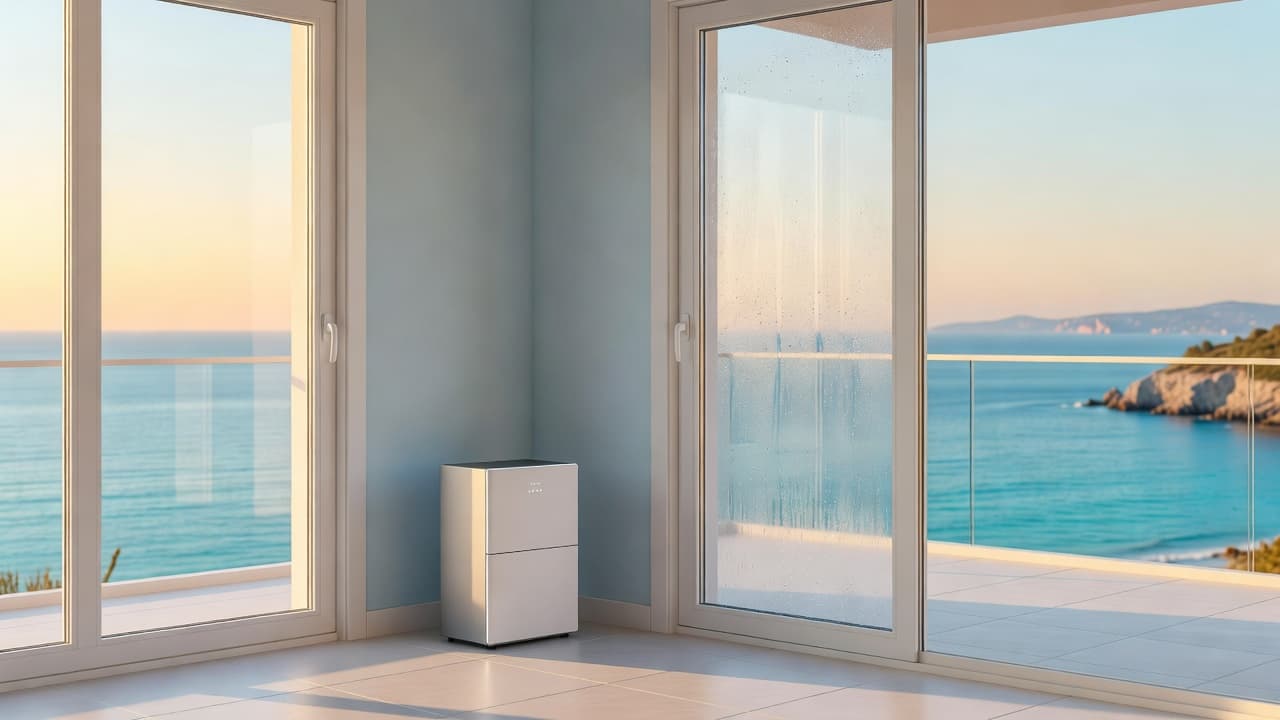
On Spain's Mediterranean coast — whether you're in the Costa Blanca, Costa del Sol, Balearic islands or Canaries — humidity is rarely below 60%, and often hovers between 70–85%, especially at night and in winter. Inland, where winters are dry and air conditioning is seasonal, you can ignore humidity. On the coast, it's persistent, salt-laden and corrosive.
Three things make coastal damp worse than standard indoor dampness:
Salt in the air. Sea salt aerosol travels inland up to 5 km and settles on surfaces. It hygroscopic, meaning it absorbs moisture from the air and accelerates corrosion of metals, electrical contacts and window frames. Your air conditioning unit, radiator, plumbing and electrical fittings are all under attack from this salt-moisture combination.
Temperature inversions and sea breezes. Coastal weather creates stable, moist air layers. Warm daytime air and cool night-time sea breezes trap humidity indoors. Your AC cools the air, but doesn't remove the water vapour efficiently.
Building fabric. Older Spanish coastal properties were often built with minimal insulation and damp-proof coursing. Ground floors, rooms facing the sea, and properties in urbanisations close to the shoreline absorb moisture into the walls themselves.
Your air conditioning unit removes some moisture — it's a side effect of cooling. Cold evaporator coils extract water from the air, and that water drains away. But here's the problem:
AC only works when it's running. In winter and spring, coastal temperatures are mild (16–18°C). You don't need cooling, so the AC stays off. But humidity stays high. Your rooms accumulate moisture all day and night without the AC's secondary dehumidifying effect.
AC is designed for cooling, not moisture removal. When you set the thermostat to 24°C and the room is already 20°C, the AC compressor doesn't run. No cooling means no dehumidification, even if the air is saturated.
AC can actually redistribute humidity. Some split systems (the common wall-mounted units in Spanish coastal homes) blow cooled, drier air into one room while exhaust moisture moves elsewhere. Ground floors and bathrooms stay damp.
This is why even homes with modern air conditioning often develop mould, musty smells and damp patches on external walls.
A dehumidifier is the right choice if:
- Your property is on or near the coast, and you notice condensation, mould or mustiness even with AC running.
- You have bedrooms, bathrooms or ground-floor rooms without air conditioning. These are humidity danger zones.
- Winter humidity bothers you (condensation on windows, damp smell in the morning). AC won't run, but a dehumidifier will work 24/7.
- You have valuable items (electronics, artwork, wood furniture, wine) that suffer from damp. Keeping humidity below 55% preserves them.
- Your electrical installations, metal window frames or plumbing show signs of salt corrosion. Lower humidity slows this.
A dehumidifier is less urgent if:
- Your entire home has good air conditioning with separate humidity control (rare in Spanish residential properties).
- You're in a modern, well-insulated flat inland with no visible damp or mould.
- Your AC is set to run constantly and you're comfortable with the energy bill. (Though a dehumidifier uses less energy than AC for moisture control alone.)
A dehumidifier won't fix:
- Rising damp from the ground (that requires damp-proof coursing and is a structural issue).
- Water leaks from pipes or roofs (fix the leak first).
- Chronic condensation in bathrooms (improve ventilation first; the dehumidifier is secondary).
Size and capacity.
For a 60–80 m² flat (typical on the coast), a dehumidifier rated at 20–30 litres of water extraction per day is sufficient. Larger villas or very damp ground floors need 40–50 litres per day. Check the manufacturer's specification for the room size and starting humidity level.
Placement.
Put the dehumidifier in the room with the worst humidity: typically a bedroom, ground floor or bathroom. Run it with the door closed to avoid spreading humid air into the unit. In a small flat, one central location works. In a villa, a single unit helps the main living areas; consider a second one for a damp ground floor or annexe.
Tank or continuous drain.
Most domestic dehumidifiers have a removable tank. In coastal conditions, this fills quickly — often within 8–16 hours in high humidity. If you don't want to empty the tank daily, choose a model with a hose outlet for continuous drain into a sink or outdoor drain. This is worth the extra expense on the coast.
Running schedule.
In summer, run it at night or in rooms without AC. In winter, run it continuously in damp-prone areas. Modern dehumidifiers have hygrostat controls: set it to stop at 50% humidity, and it will cycle on and off automatically. This saves energy.
Humidity meter.
Buy a cheap hygrometer (under €10) to measure the room's humidity. Aim for 40–50%. Below 30% is uncomfortable and can damage wood. Above 60% encourages mould. Coastal homes often sit at 70%+, so bringing it down to 55% is a major improvement.
If you're dealing with active mould or severe damp, a dehumidifier is a containment tool, not a cure. Until you address the root cause (usually ventilation, a leak, or salt corrosion affecting the building envelope), do this:
Increase air circulation. Open windows on calm days to exchange air. Avoid opening windows when it's humid outside (early morning, after rain, when sea breeze is strong). Late afternoon and evening are usually drier on the coast.
Run the dehumidifier continuously in the affected room. Empty the tank daily if necessary.
Wipe down condensation on windows and walls each morning. This removes the moisture-rich film where mould spores germinate.
Check bathroom extraction fans and kitchen hoods. Make sure they're actually extracting to the outside, not just recirculating humid air. Spanish homes often have blocked vents.
Move furniture away from external walls to allow air to circulate. Wardrobes, beds and sofas trapping air against cold, damp walls are mould incubators.
If a dehumidifier controls the symptoms but the underlying damp continues, call an air conditioning or handyman specialist. They will:
Inspect the building envelope. Check window seals, door frames and external walls for salt spray damage and water ingress. A property exposed to direct sea wind will have accelerated deterioration.
Test ventilation. Make sure bathroom, kitchen and laundry extraction vents are clear and ducted to the outside. In older Spanish homes, these are often blocked or non-existent.
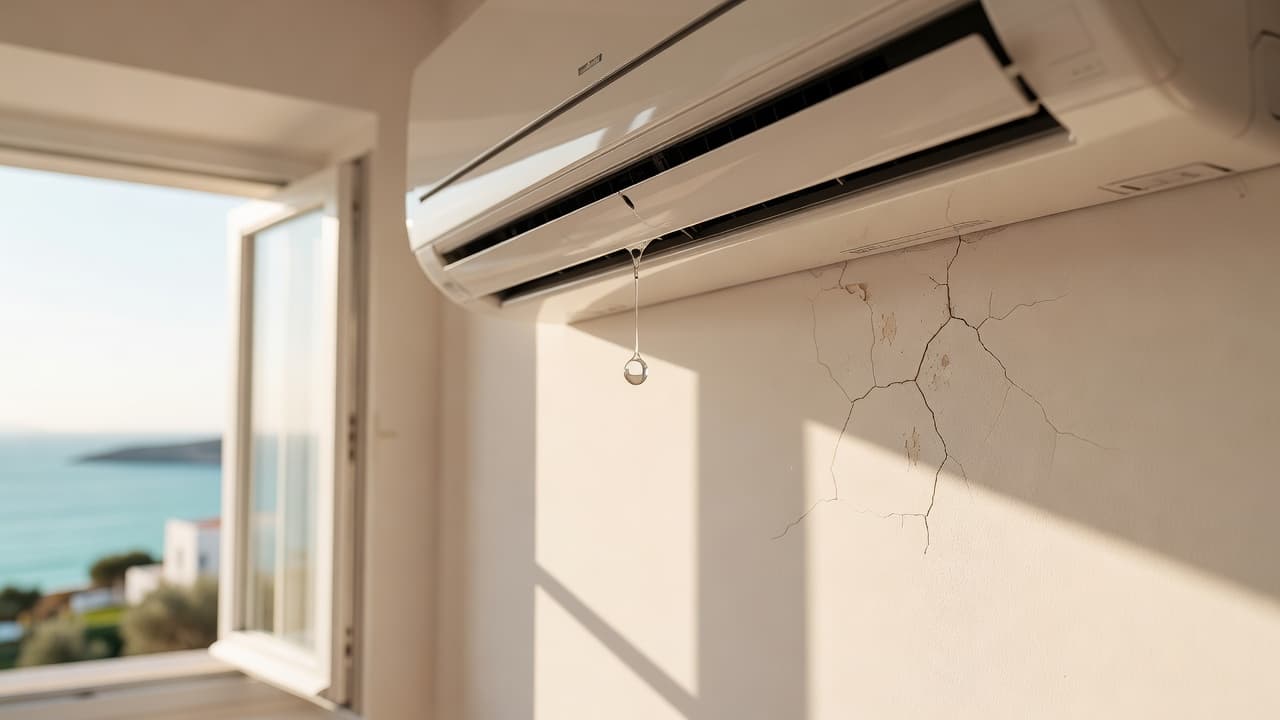
Check the air conditioning unit. A poorly maintained AC system will have clogged coils and won't dehumidify efficiently. They'll clean the unit and may recommend a service contract.
Assess humidity-control options. In severe cases, they may suggest:
- Installing a mechanical ventilation system with heat recovery (common in Northern European homes, less so in Spain).
- Upgrading to an AC unit with advanced dehumidification (inverter models and heat pumps are better at this).
- Treating external walls with breathable render or improving insulation to reduce surface condensation.
These are longer-term solutions and cost more, but they address the root cause rather than symptoms.
Once you've stabilised humidity with a dehumidifier:
Run it seasonally, not wastefully. In summer, rely on AC during the day and the dehumidifier at night. In winter, run it in damp rooms only (bedrooms, ground floors). Spring and autumn are humid on the coast; run it continuously.
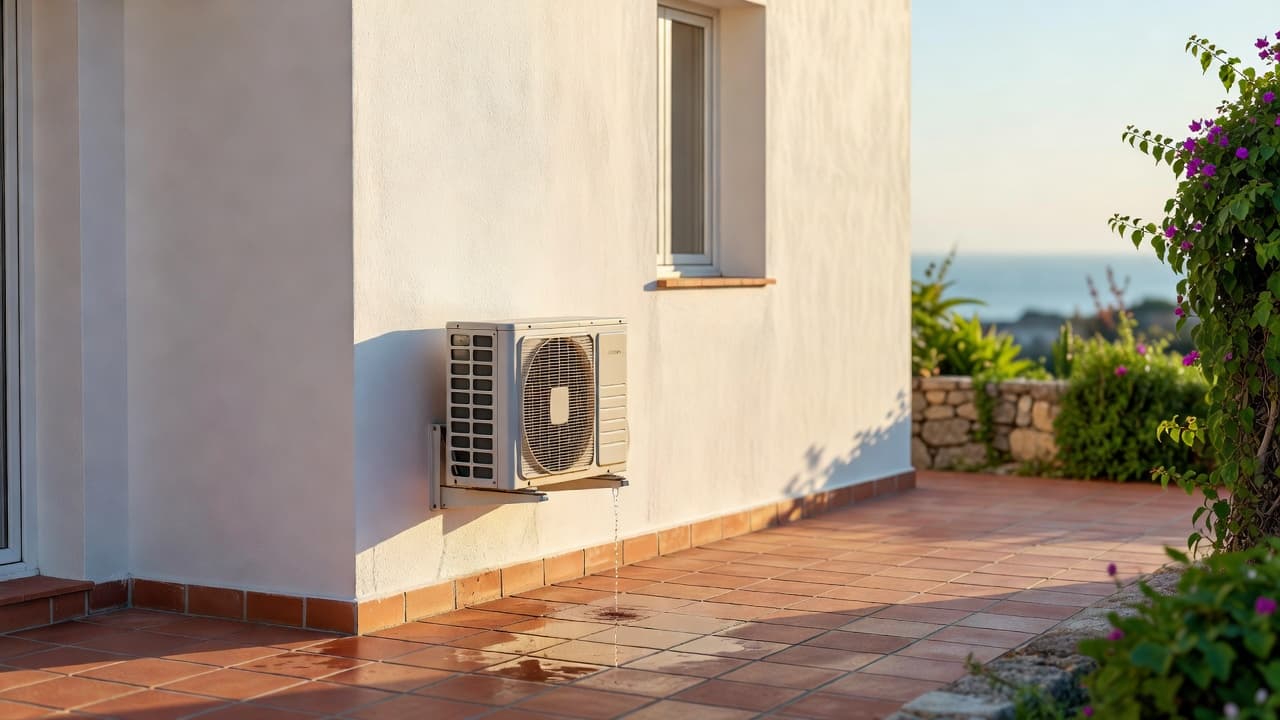
Service your AC unit annually. Clean filters, have the evaporator coils checked, and ensure the condensate drain is clear. A technician can do this in 1–2 hours.
Maintain external seals. Check window and door frames twice a year for salt corrosion and cracked seals. Replace silicone seals on windows if they're deteriorated. This stops salt-laden air entering.
Ventilate wisely. Open windows early evening to late night, when coastal air is usually drier. Close them before dawn and during peak humidity hours (early morning, after rain).
Monitor humidity. Keep a hygrometer in the main living area. If humidity regularly exceeds 60% even with the dehumidifier and AC running, there's a ventilation or structural problem that needs professional attention.
A dehumidifier won't replace your air conditioning or fix structural damp, but on Spain's Mediterranean coast, it's often the missing piece. If you're dealing with persistent humidity, mould or that salt-damp smell that won't shift, start with a dehumidifier and see the difference within two weeks. If the problem continues, our air conditioning specialists can diagnose the underlying cause and recommend a long-term solution tailored to your coastal home.