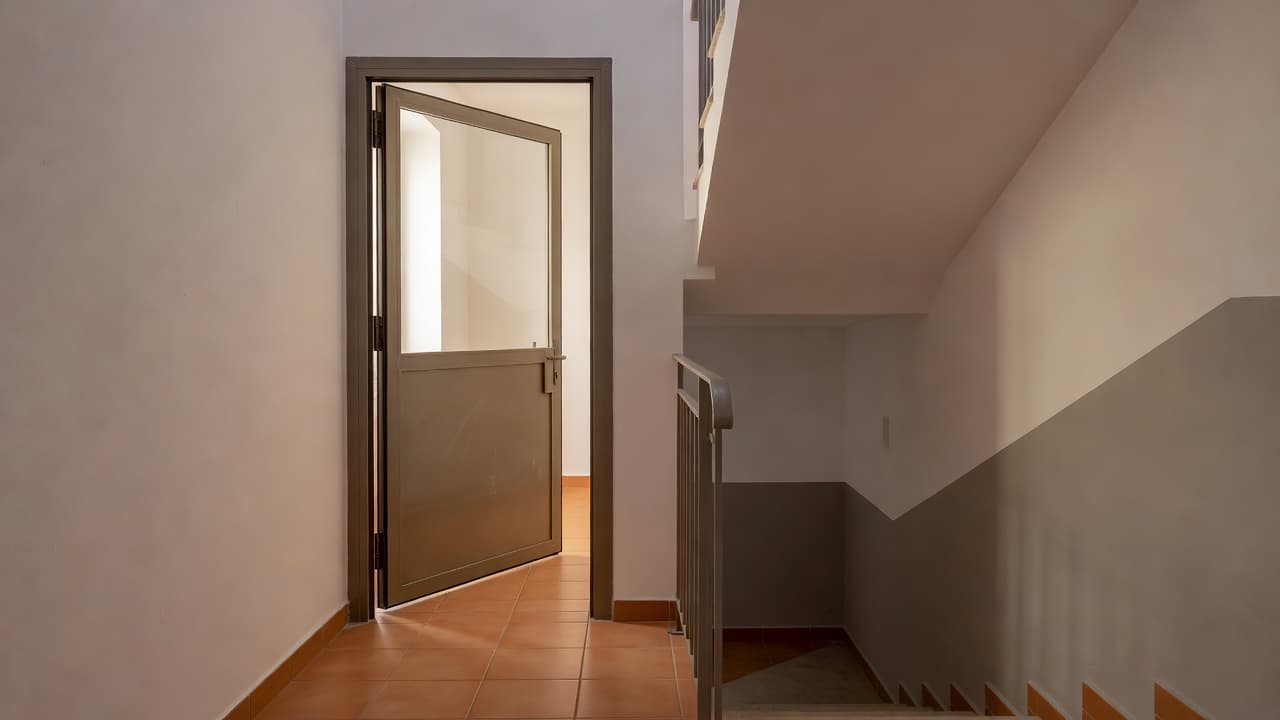
In a Spanish building with multiple flats (a comunidad de vecinos, or community of owners), communal fire doors are installed to meet building regulations. Their job is to contain smoke and flames within a small area—typically a stairwell, landing, or corridor—so fire doesn't spread rapidly through the whole building.
If a fire breaks out in one flat, a working fire door gives everyone else precious minutes to evacuate safely. A door that won't close removes that protection.
Fire doors are heavy and built to last, but the self-closing mechanism (a pneumatic or hydraulic device called a closer) can wear out, become damaged, or lose pressure. In coastal areas—especially on the Costa Blanca, Costa del Sol, or the Balearics—salt air can corrode the mechanism, making it stick or fail.
The most common causes are:
- The closer has lost pressure. The hydraulic fluid inside has leaked. The door closes slowly or not at all.
- The closer arm is bent or damaged. This can happen if someone has forced the door open or hung something heavy on it.
- Dirt or salt corrosion in the mechanism. On the coast, salt spray enters the closer housing and gums it up.
- A wedge or stopper has been placed underneath. Someone has propped the door open (sometimes intentionally, to keep it open during daytime for convenience). Remove any wedge you see, but don't adjust the mechanism.
- The door frame has warped. The door no longer sits properly in the frame, causing friction.
Until the professional arrives to fix it:
- Don't force the door open or closed. Let it close naturally at its own pace.
- Don't prop it open with a wedge, doorstop, or object, even if it's slow to close. I know it's inconvenient, but an open fire door is useless in a fire.
- Don't spray lubricants or WD-40 on it. This can damage the mechanism further.
- Leave it as it is and let the professional assess it.
Stop and call the professional immediately if:
- The door is visibly bent or damaged.
- There is fluid leaking from the closer unit (a small box on the top of the door or the door frame).
- The door moves erratically or gets stuck partway.
- You hear hissing sounds from the closer (sign of internal damage).
- Anyone has previously tried to "adjust" the closer and made it worse.
Fire door closers are pressurised units. Mishandling them can cause injury or permanent damage. A locksmith or specialist door maintenance technician must do the work.
If you live in a flat within a community of owners (comunidad de vecinos):
Contact the building administrator (administrador de la comunidad) or the president of the community. Their details should be on your community charges invoice, on the notice board in the lobby, or in your community bylaws. Send an email with:
- A clear description: "Fire door on the third-floor landing won't close by itself."
- The date and time you noticed the problem.
- Your photos.
- Your flat number.
Keep a copy. The administrator has a legal responsibility to maintain common areas, including fire safety.
If the administrator doesn't respond within 3–5 days:
- Send a follow-up email marked "Urgent – Safety Issue".
- If still ignored, email the community president and all community board members (if you have their addresses).
- Consider sending a formal registered letter (burofax) to the community, keeping proof of delivery.
If the community continues to ignore it:
- Contact your local town hall (ayuntamiento). Most have a building inspection department (inspección técnica de edificios). Explain the fire door defect and that the community has not acted.
- The town hall can issue a compliance notice, which carries legal weight.
Fire safety is not optional—it's regulated by Spanish building law (Código Técnico de Edificación, or CTE). Communities that ignore safety defects can face fines and legal liability.
If you own a holiday home or villa and it's not part of a community:
If your fire door is in a detached house or a private property, you are responsible. Contact a locksmith or door maintenance specialist directly. The cost is yours, but there's no delay waiting for community agreement.
When a locksmith or door specialist arrives, they will:
- Inspect the closer mechanism to determine if it can be serviced (re-pressurised, cleaned, adjusted) or must be replaced.
- Test the door's operation. They'll open and close it several times, checking the speed, smoothness, and the force needed.
- Check the door frame and hinges for warping or damage.
- Service or replace the closer. If it's repairable, they'll refill the hydraulic fluid and adjust the closing speed. If it's damaged or worn beyond repair, they'll fit a new closer unit.
- Hand you a receipt and, if required, a maintenance certificate showing the work done and the date. Keep this—it's proof the defect was fixed.
The cost varies depending on whether the closer is serviced (usually €80–200) or replaced (usually €150–400), plus labour. Ask for a quote upfront. The community should pay, as it's a common-area expense.
- Don't wedge fire doors open. I know they're inconvenient, but they must be free to close. If you need ventilation, open a window.
- Don't hang things on fire doors. Coats, bags, or items hung on the handle add strain to the mechanism.
- Report problems early. A slow-closing door is an early warning. Report it before it fails completely.
- Community maintenance schedule. Ask your administrator if there's an annual inspection programme for fire doors. There should be.