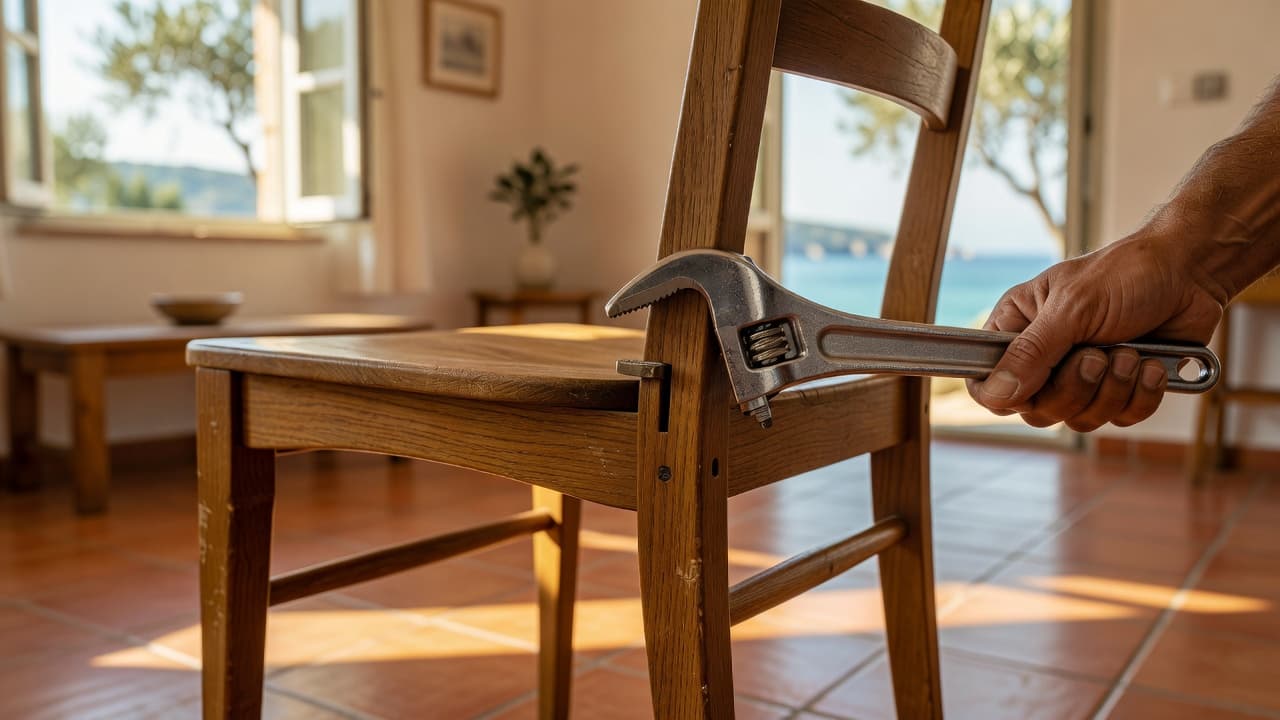
Creaking almost always comes from movement in the joints where two pieces meet. Here's what causes it:
Loose bolts or screws are the most common culprit. Over time, vibration and use work these fasteners loose. You'll hear a creak when pressure is applied and the wood flexes slightly.
Wooden dowels that have shrunk are common in traditional wooden chairs. A dowel is a wooden peg that holds two pieces of wood together. If the wood has dried out, the dowel becomes loose in its hole, and the joint rocks slightly when you sit down.
Worn or damaged joints happen when wood splits around a bolt hole, or when the joint socket becomes enlarged and the bolt can no longer hold it tight. This is more serious and often needs replacement.
Seasonal humidity changes are especially significant on the Mediterranean coast. In summer, heat and humidity cause wood to expand. In winter, it contracts. These tiny movements loosen joints over time. If your chair creaks worse in July than in January, this is likely the reason.
Metal brackets or corner braces that have corroded or come loose (found on some modern or reinforced chairs) can creak as they move against the wood frame.
If you've identified loose bolts or screws, you can tighten them safely yourself in most cases.
For bolts visible on the outside of the chair:
Use an adjustable spanner or the correct sized fixed spanner to hold the bolt head while you turn the nut on the underside with another spanner. Tighten firmly, but do not over-tighten — you're looking for snug, not crushed. Wooden furniture isn't a car engine. If you strip a bolt hole, you've made the problem worse.
For screws:
Use a screwdriver that fits the screw slot properly. Turn clockwise until you feel resistance. Again, snug is the goal, not maximum force.
For hidden bolts accessed from underneath:
Flip the chair or stool safely (or work with someone else's help). Locate the bolt. Tighten using two spanners as described above.
After tightening, sit on the chair gently and listen. Has the creak stopped? If yes, you've fixed it. If no, there may be a second loose point, or the problem is deeper (a split joint, a worn socket, a damaged dowel).
Do not use wood filler, glue or any adhesive as a temporary fix. These might hold for a day or two, but they're not structural. They make professional repair harder and can make the chair less safe, not more.
Stop and call a professional handyman if you notice any of the following:
The joint is visibly cracked or split (a line of damage in the wood around the bolt hole or joint). This means the wood has been compromised and needs reinforcement or replacement.
You can see light between pieces that should be touching, and tightening bolts doesn't close the gap. The joint socket may be enlarged or the wood may have warped.
The dowels are loose and the joint rocks side to side even after you've tightened the bolts. Wooden dowels can't be simply re-tightened; they need to be removed, replaced or the joint re-glued. This requires craft skills and proper clamps.
The backrest leans backward noticeably, or a leg splays outward. This suggests structural damage beyond loose fasteners.
You've tightened everything you can find and the creak persists. The problem may be internal, in a joint you can't reach, or a weakness in the wood itself.
You find metal corrosion or rust on bolts or brackets. Rust weakens metal and can cause sudden failure. A handyman can assess whether the structure is still safe or if replacement is needed.
In any of these cases, the chair is unsafe to use regularly. Book a handyman to inspect and repair it properly. Meanwhile, use a different seat.
A handyman experienced in furniture repair will start by identifying exactly where the weakness is, using the same rocking and wiggling method you used, but with trained eyes for damage you might have missed.
Depending on what they find, they'll either tighten loose fasteners (the job takes 15–30 minutes), or they'll disassemble the joint, assess the damage, and repair or replace the damaged parts. If dowels need replacing, they'll carefully remove the old ones (sometimes drilling them out), clean the joint, glue new dowels in place, and clamp the joint tight while the glue sets. This takes longer — typically 1–2 hours plus drying time — but the chair will be properly restored.
For corroded bolts, the handyman will remove and replace them with new stainless steel fasteners if the chair is near a kitchen or bathroom (where salt air and humidity are higher on the coast) to prevent rust happening again.
The professional will also check for splits in the wood. Small splits can be filled and reinforced. Large splits may mean the piece needs to be replaced, though a skilled handyman can often repair rather than replace, keeping your chair original and structurally sound.
Check your furniture every 6 months. Gently rock chairs and stools. Listen for creaks. If you hear one, tighten the loose bolt or screw immediately — it takes 2 minutes and prevents the problem getting worse.
Be aware of humidity changes. On the Mediterranean coast, wood expands in summer and contracts in winter. Joints that are already slightly loose will creak more in hot months. Don't wait until July to check — do it in May.
Avoid dragging chairs across tiles or stone. This puts stress on the legs and joints. Lift and carry them instead.
Don't overload the furniture. A chair designed for one person won't hold two safely, and the extra stress loosens joints faster.
If the chair lives on a terrace or balcony, bring it inside during winter. Exposure to salt air and damp accelerates corrosion and wood movement. Even treated wood suffers over time.
Use the right furniture for the space. A lightweight fabric chair bought on holiday probably wasn't designed for daily use in a permanent home. If something seems too delicate or flimsy, it probably is.
If your chair is still creaking after you've tightened what you can reach, or if you've found cracks, splits or severely worn joints, book a professional handyman to assess it properly. A good repair now prevents an accident later and keeps your furniture in use for years to come.