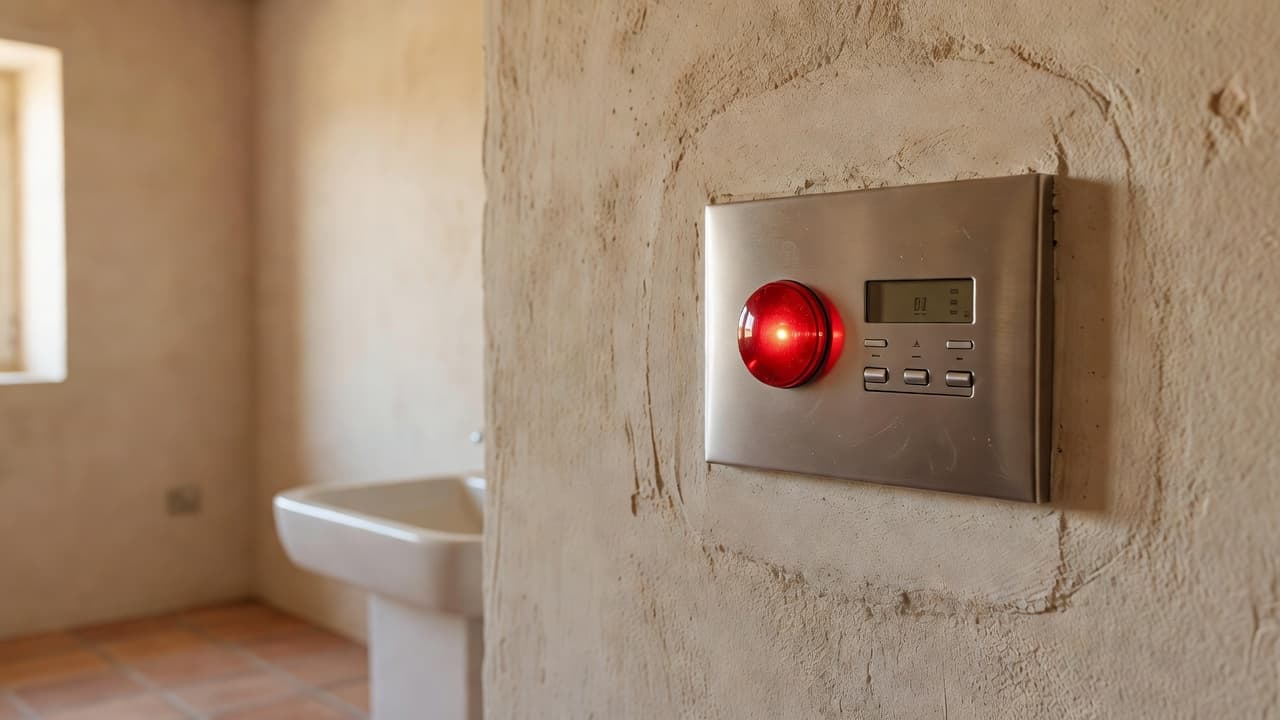
A red warning light means the boiler's safety system has detected a fault and shut down operation to prevent danger. The most common causes are:
Ignition failure. The boiler is trying to light the gas flame and failing. This can happen because of a blocked nozzle, a faulty electrode, air in the gas line, or low gas pressure.
Flame loss. The boiler lit successfully but then the flame went out. This usually means the gas supply is unstable, the burner is dirty, or the sensor that detects the flame isn't working.
Overheating. The boiler has reached an unsafe temperature, usually because the water circulation has stopped. A blockage in the pipes, a failed pump, or a stuck valve can cause this.
Low water pressure. Many boilers have an automatic safety cutoff if the pressure inside falls too low. You may see this on a small gauge on the front of the boiler.
A leak or crack. If the heat exchanger (the part that transfers heat from the burning gas to your water) has cracked, water and combustion gases can mix. This is serious and the boiler must not be used.
Electrical or sensor fault. A loose connection, a corroded component, or a failed electronic part can trigger the fault light without any danger being immediately present—but the boiler is still unsafe to use without diagnosis.
Smoke from a boiler is more serious. It usually indicates a combustion problem (incomplete burning, which produces soot and smoke), a leak from inside the boiler housing, or a very hot internal component coming into contact with debris or water.
Check the water pressure. Look at the small pressure gauge on the front of the boiler (usually a dial showing a scale from 0 to 3 bar, with a green zone around 1–1.5 bar). If it's below 1 bar, your system may have lost water. There should be a filling loop (a flexible tube with a small lever valve) connected under the boiler. Do not use this if you're uncomfortable with it—water pressure adjustments are sometimes better left to a professional, especially if you don't know the system. If you do try: close the loop valve when the pressure reaches 1.5 bar, then try resetting the boiler.
Bleed air from the system (if you have a small bleed screw on the boiler). Sometimes air in the system can prevent ignition. There may be a small bleed screw (usually at the top of the boiler or on a nearby pipe, looking like a tiny tap). Turn it slowly with a flat-head screwdriver until a little water comes out—this pushes out trapped air. Stop and close it. Then reset the boiler.
Check that the gas isolation valve is open. The small lever on the gas pipe should be parallel to the pipe (not perpendicular to it). If it's perpendicular, the gas is cut off. Turn it to parallel and try resetting the boiler.
Keep other rooms warm. If you can't use the boiler and it's cold outside, close off rooms you don't need and use portable electric heaters in the spaces where you're spending time. Never leave a portable heater unattended, and keep it at least one metre from curtains or other flammable materials.
Run the cold water tap. To confirm the boiler isn't supplying hot water, turn on a hot tap. If nothing comes out or it's lukewarm, the boiler has shut down as expected.
Stop immediately and call a professional if:
- You see active smoke or flames coming from the boiler casing.
- You smell gas (a rotten egg or sulphur smell). This is extremely serious. Evacuate, close the door, and call the emergency services or your gas supplier.
- The boiler is too hot to touch (you should be able to hold your hand near it for a few seconds without discomfort). An overheating boiler can overheat the surrounding area and cause a fire risk.
- You see water pooling underneath the boiler or visible cracks or rust holes in the casing.
- The red light returns immediately after a reset, especially if it happens repeatedly within an hour.
- The boiler won't reset at all—the button does nothing or the light stays on regardless.
- You see black soot marks around the boiler casing, on the flue (exhaust pipe), or inside the cabinet. This indicates incomplete combustion and a potential fault.
- The error code shows a number you don't recognise and your manual isn't available. A professional will decode it faster than you can search for it online.
In any of these cases, the boiler must not be used, and a qualified gas engineer must inspect it. Using a faulty boiler can lead to carbon monoxide poisoning, gas leaks, or fire.
A qualified gas engineer (an engineer on the MyCasa Spain network of gas and heating professionals will usually follow this process:
1. Visual inspection and code reading. They'll look at the boiler, note the error code, and check for obvious signs of damage, corrosion, or leaks. They'll also inspect the flue and nearby pipes.
2. System pressure and electrical checks. They'll confirm the water pressure is correct, check the electrical connections, and test the ignition and flame sensor. Many faults are caused by loose connections or corroded terminals that can be cleaned or tightened.
3. Gas supply check. They'll verify that gas is reaching the boiler at the correct pressure. If not, the problem may be in the supply line, not the boiler itself.
4. Component testing. If the simple checks don't reveal the issue, they'll test individual components—the electrode, the pump, the thermostat—to identify the faulty part.
5. Repair or replacement. Depending on what they find, they'll either repair the component (cleaning, adjusting, reseating) or replace it if it's damaged beyond repair. Some repairs are quick; others (like a cracked heat exchanger) may mean the boiler needs replacing.
6. Safety check and paperwork. After the repair, the engineer will reset the boiler, run it through a heating cycle to confirm it's working, and often perform a safety test (checking gas pressure, combustion quality, and water pressure). They should hand you a certificate or record of what was done.
The entire process usually takes 1–2 hours, depending on the fault. If the boiler is very old or the fault is serious, the engineer may advise replacement rather than repair.
Annual servicing. A yearly service by a qualified engineer keeps the boiler clean, checks all safety components, and catches small problems before they become faults. This is especially important on the Mediterranean coast, where salt air can accelerate corrosion of metal components.
Monitor the water pressure gauge. If you notice it's dropping slowly over weeks or months, this suggests a small leak somewhere in the system. A professional can find and seal it before it becomes serious.
Bleed radiators if they feel cold at the top. Air in the system reduces water circulation, which can cause overheating. Most homes have bleed screws on radiators (small square valves at the corner). Turn them gently with a radiator key until water (not air) comes out, then close. If you're unsure, ask the engineer to do it during their next visit.
Keep the boiler area clear. Don't store items, cleaning products, or fabrics near the boiler. These can block air vents or catch fire if the boiler overheats.
Don't ignore small warning signs. If the boiler takes longer to ignite, if you hear unusual noises, or if the hot water pressure is weaker than usual, these are hints that something is starting to fail. Calling a professional early is cheaper than waiting for a complete breakdown.
Your boiler is warning you for a reason. Don't ignore it and don't keep resetting it hoping it will go away. A few hours without heating while a professional fixes the problem is far safer than risking a gas leak, carbon monoxide, or fire.
Get in touch with one of our qualified heating engineers through MyCasa Spain. We can connect you with a professional in your area who speaks English, German, or Dutch and can diagnose the fault and repair or replace your boiler quickly.