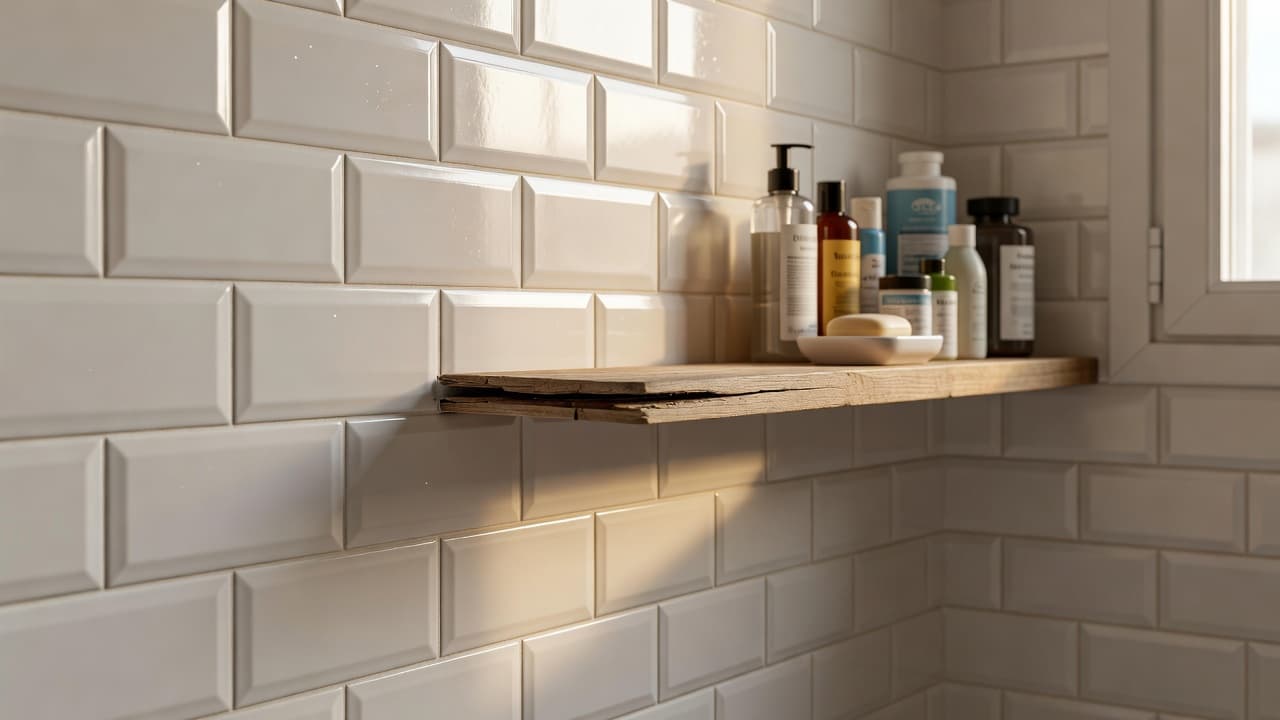
Bathroom shelves pull away from walls for three main reasons:
Anchor failure. The original anchors — usually basic plastic wall plugs — give up under weight, moisture, or time. In homes near the Mediterranean coast, salt air and humidity corrode metal screws inside plastic anchors, weakening their grip. After 5–10 years, even well-installed anchors can fatigue.
Wrong anchor type for the job. Many budget shelves come with lightweight plastic anchors rated for 5–10 kg per pair. A bathroom shelf loaded with a couple of towel rolls, bottles of shampoo, and decorative items easily exceeds that. The anchors were never strong enough.
Impact or vibration. A heavy bump (e.g., from cleaning or a child pulling on the shelf) can jar an anchor loose. Coastal properties also experience minor vibrations from wind or nearby traffic that, over time, loosen fixings.
Moisture and wall type. Spanish homes near the coast often have concrete or breeze-block walls under plaster. If the plaster is thin or poorly sealed, moisture infiltrates and weakens the anchor's grip. Ceramic tiles (typical in bathrooms) are fine, but the wall behind them may be compromised.
Option 1: Replace the anchors (if the shelf is removable).
If you've removed the shelf, this is the simplest fix. You need:
- A small spirit level.
- A drill with a bit matching the anchor size.
- Heavy-duty plastic toggle anchors or metal cavity fixings (available at any Spanish hardware shop — ask for "tacos de expansión" or "tacos metálicos").
- New screws rated for the anchor type.
- Lay the shelf flat on a work surface.
- Clean out the old anchor holes with a dry cloth — remove any debris or crumbled plaster.
- If holes are enlarged, drill them to the next standard size (usually 8mm or 10mm) and use correspondingly larger anchors.
- Insert new heavy-duty anchors into the holes. Tap them gently with a hammer until flush.
- Screw the shelf back to the wall, ensuring the back edge is tight against the wall and the shelf is level.
- Start light: place only light items (a toothbrush holder, a single towel) for the first week. Monitor for movement.
Option 2: Install a temporary support bracket (if you can't remove the shelf).
If the shelf is bonded to the wall or you're renting and can't drill new holes, a temporary wooden support bracket underneath will carry the load.
- Clear the shelf entirely.
- Source a small L-shaped wooden bracket (about 15–20 cm tall, available at hardware shops) or ask a handyman to install one.
- Position it underneath the shelf at the point of greatest sag (usually the middle or outer end).
- Secure the vertical part of the bracket to the wall using heavy-duty anchors (not just adhesive).
- The horizontal part should support the shelf's underside snugly but not force it upward — it's a safety net, not a jack.
- The bracket is temporary and cosmetically obvious, but it takes weight off the wall anchors and stops further damage.
Option 3: Redistribute weight (immediate but temporary).
If you must keep items on the shelf for now:
- Place only essential items.
- Concentrate weight towards the wall (where anchors are strongest) rather than the outer edge.
- Avoid stacking heavy bottles. Use the counter space instead.
- Remove this temporary arrangement as soon as brackets or anchors are upgraded.
Stop and call a handyman service on the Mediterranean coast immediately if:
The shelf is high above the toilet or bathtub and heavily loaded. A falling shelf from height into the tub or onto someone is a safety hazard. Let a professional handle it.
The wall has large cracks, visible water damage, or soft spots. This suggests structural issues or dampness beyond a shelf problem. A handyman needs to assess the wall before any installation.
The anchors have pulled right through the wall, leaving large holes. This means the wall material is compromised. Filling holes and re-anchoring requires proper assessment.
The shelf is tilting or has a visible bow. The shelf itself may be damaged or the wall is uneven. A professional will check both before reinstalling.
You've already tried to fix it once and it failed again. Repeated failure means the root cause (wall type, moisture, or anchor choice) wasn't addressed. A professional will diagnose and fix it properly.
The shelf is made of glass or a fragile material. Don't risk it. A professional will handle removal and reinstallation safely.
A handyman will start by removing the shelf fully and inspecting both the anchors and the wall.
They'll check the wall material (concrete, breeze-block, or plaster), look for moisture signs, and assess whether the existing anchor holes can be reused or need relocating. If the wall is damp near the shelf, they may recommend dealing with that first — moisture is a common cause of repeat failures.
They'll then select the right heavy-duty anchors for your wall type. On the Spanish coast, they'll likely use metal cavity fixings (tacos de expansión de metal) or heavy-duty plastic toggles, which grip far more reliably than basic plugs. These are rated for 20–40 kg per pair and won't fail from salt air or vibration.
Before rehang the shelf, they'll use a spirit level to check the wall is plumb and the shelf will sit evenly. They'll confirm the shelf's weight limit and advise you on safe loading.
Once installed, they should provide a receipt and confirmation that the work meets the Spanish building standard for fixtures. This matters if you're selling the property later.
Don't exceed the shelf's weight limit. If you've installed new heavy-duty anchors (20–40 kg capacity), that doesn't mean you should load the shelf to capacity. Keep it at 60–70% of limit to leave a safety margin.
Distribute weight evenly. Don't pile heavy items on one side. Spread them across the shelf's length.
Check anchors annually, especially near the coast. Every 12 months, gently push up on the shelf's outer end. If it moves more than a millimetre or two, tighten screws or call a handyman. Salt air degrades fixings faster than inland homes.
Avoid repeated impacts. Don't use the shelf to steady yourself or lean on it. Bathrooms are high-traffic areas — teach family members the shelf isn't a grab rail.
Consider a professional installation if you're renting or unsure. A proper installation costs 80–150 euros but saves repeat failures and damage deposits.
Bathroom shelves don't repair themselves, and delaying makes the problem worse. If your shelf is visibly pulling away from the wall, remove everything from it today. Either upgrade the anchors yourself with heavy-duty fixings or arrange a professional shelf installation to do it properly. A few days' delay could mean the difference between a £100 repair and water damage from a fallen shelf.
Contact a handyman on the Mediterranean coast to assess your shelf and reinstall it safely. They'll ensure it won't pull away again.