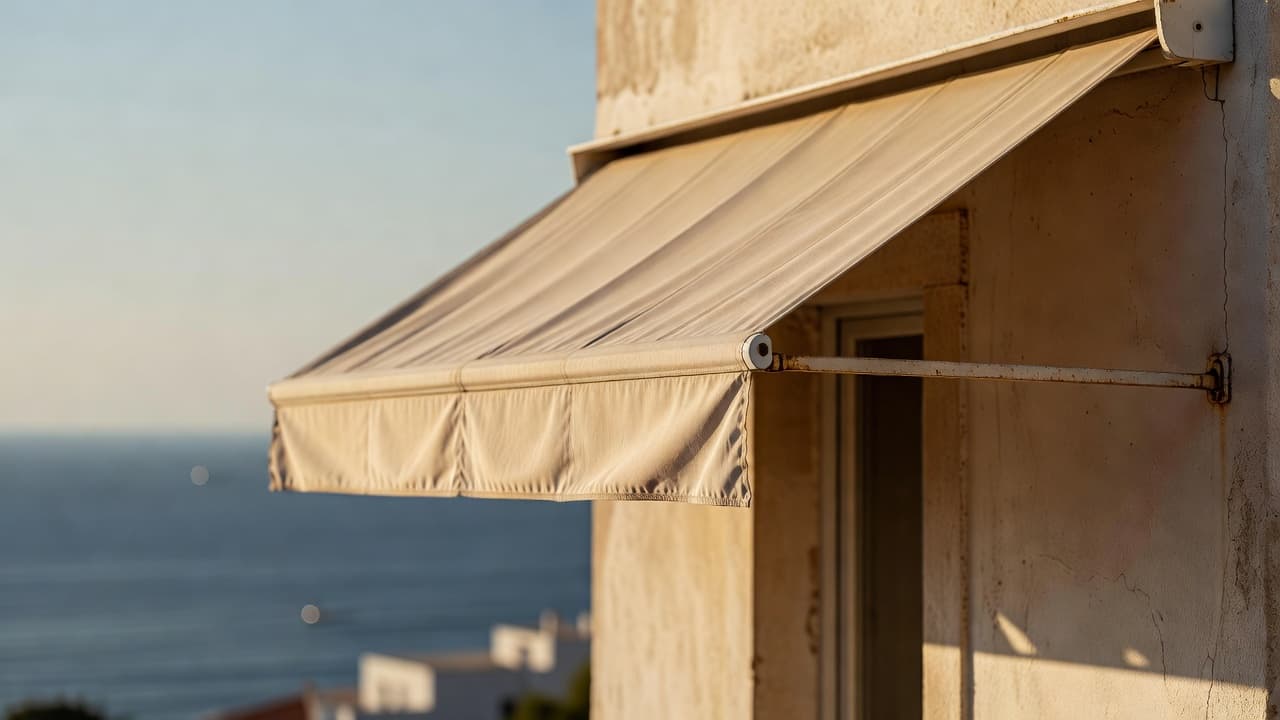
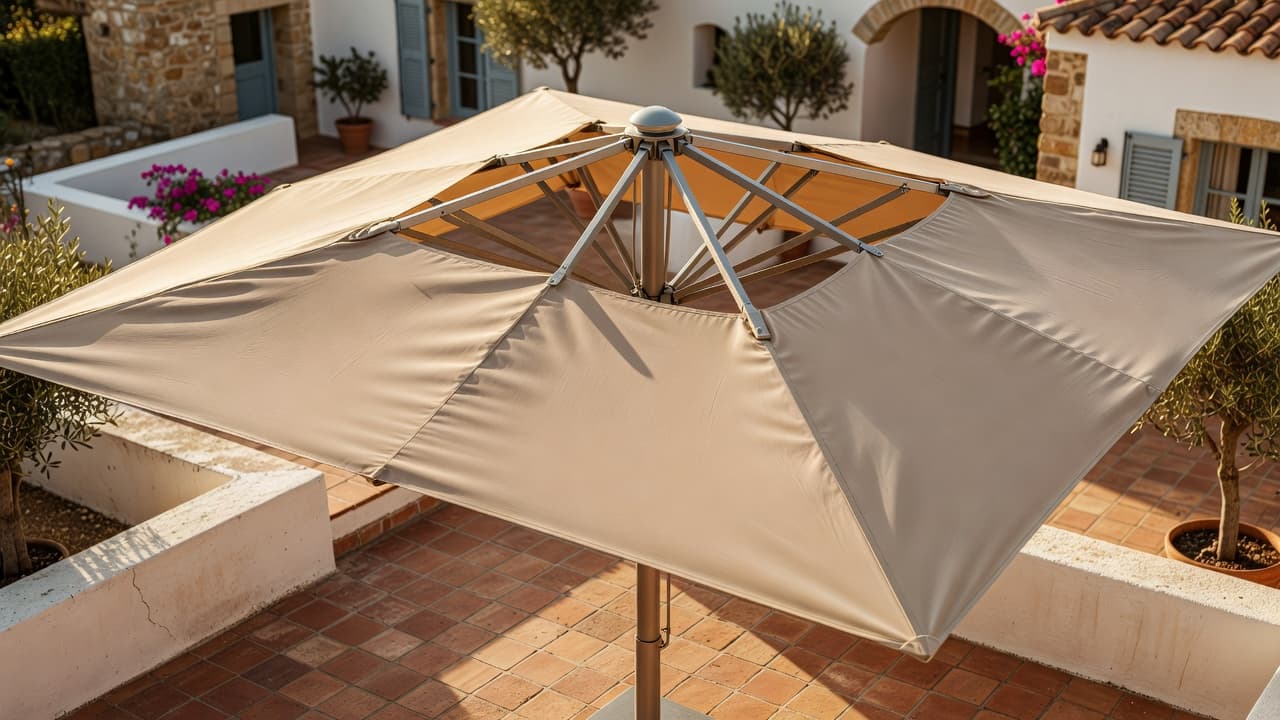
A loose awning on one side usually means one of the mounting brackets has shifted or partially failed. The causes vary depending on your location and the age of the awning:
Salt air corrosion. If you live on or near the Mediterranean coast, salt air attacks metal bolts and brackets over time. The bolt may rust and weaken, or the bracket itself may corrode and lose its grip on the wall.
Vibration from wind stress. Coastal properties face constant wind. Over months and years, the repeated movement loosens bolts. The bracket pulls slightly away from the wall with each gust, creating a gap.
Age of the mounting hardware. An awning installed five, ten, or more years ago may simply have worn-out fixings. Metal hardware has a lifespan.
Direct impact or collision. A fallen tree branch, a badly parked car, or accidental contact from a ladder can bend a bracket or crack a bolt.
Improper initial installation. If the awning was not anchored to solid masonry (e.g. it was fixed to rendered plaster instead of the brick underneath), the fixings can pull out over time.
These actions will keep your awning safe and immobile without risking your safety:
Secure the loose edge to the ground or a fixed point. Use strong nylon rope, clothesline, or even a ratchet strap. Tie it so the canvas or panel cannot flap. If the entire awning is drooping, you may need two or three tie-points to keep it level and stable.
Close the awning fully and leave it closed. If it is motorised and the motor is still working, retract it completely and do not re-open it until the repair is done. If it is manual, crank it in and leave it.
Place a "do not use" sign or barrier underneath if others share your home or property. You do not want a child or a visitor standing beneath something that could fall.
If one bracket is clearly bent or broken, do not attempt to straighten it. Leave it alone. The temporary rope fix is enough until the professional arrives.
Do not apply lubricant or penetrating oil to the bolts in an attempt to free them. This will not fix the problem and may make the situation worse if the bolt then turns unpredictably.
Call a professional immediately—do not attempt a DIY repair—if any of these apply:
- The awning is sagging so much that you can see daylight between the bracket and the wall. The bracket is no longer in contact with the masonry. This is structural failure.
- The bracket itself is visibly bent, cracked, or deformed. It has already failed and cannot be safely retightened.
- You cannot safely reach the loose section without a ladder at height. Working on a ladder to tighten bolts on a structure under wind stress is dangerous.
- The awning is motorised and the motor is still trying to open or close it. Do not interfere; you risk electrocution or the motor driving the broken bracket further.
- The canvas is torn or the frame is visibly damaged. Securing it may not be enough. Structural repair is needed.
- The loose edge is above a neighbour's property or a public thoroughfare. This is a liability issue. A professional repair is your legal protection.
If any of these conditions are present, stop, secure the awning as best you can with rope, and phone the handyman today.
When the professional arrives, they will first inspect the mounting brackets and the wall attachment. They will look for corrosion, bent metal, cracked bolts, or damage to the wall itself.
In most cases, the repair is straightforward. One or both brackets need to be tightened, or the bolts replaced with new stainless steel fixings (which resist salt air corrosion). If the wall has weakened—rendered plaster has crumbled, for example—they may need to relocate the bracket to solid masonry a few centimetres higher or lower.
If the bracket or frame is damaged, the handyman will remove the entire awning, replace the faulty hardware, and reinstall and test it. This takes longer and costs more, but is necessary to restore safety.
The handyman will use appropriate fasteners. For coastal properties, stainless steel bolts and washers are essential. These resist the salt air that would corrode standard steel within months.
They will test the awning's movement before leaving, opening and closing it fully (if motorised) or cranking it by hand to ensure everything moves smoothly and the brackets are under equal tension.
You will receive documentation if any structural work was needed (e.g. if new holes were drilled). Keep this for your records and for any future buyer.
Check your awning twice a year, especially if you live on the coast. Look at the brackets where they meet the wall. If you see rust, gaps, or movement, book a service call early rather than waiting for it to fail.
If the awning is motorised, test it monthly. Open and close it fully and listen for squeaking, grinding, or any sign of strain. These are early warnings.
Use a stainless steel or galvanised fastening kit when brackets are replaced. Do not skimp on hardware.
After a very windy spell, particularly if your home faces the prevailing wind, do a quick visual check. Wind stress is cumulative.
If the awning will be unused for long periods (e.g. winter or whilst you are abroad), retract it fully and leave it closed. This reduces stress on the fixings.
A loose awning is a red flag, but it is fixable. Secure it immediately so it cannot move in the wind, then get a quote from a local handyman who can reattach or replace the mounting hardware safely. Most repairs happen quickly and prevent much bigger problems down the line.