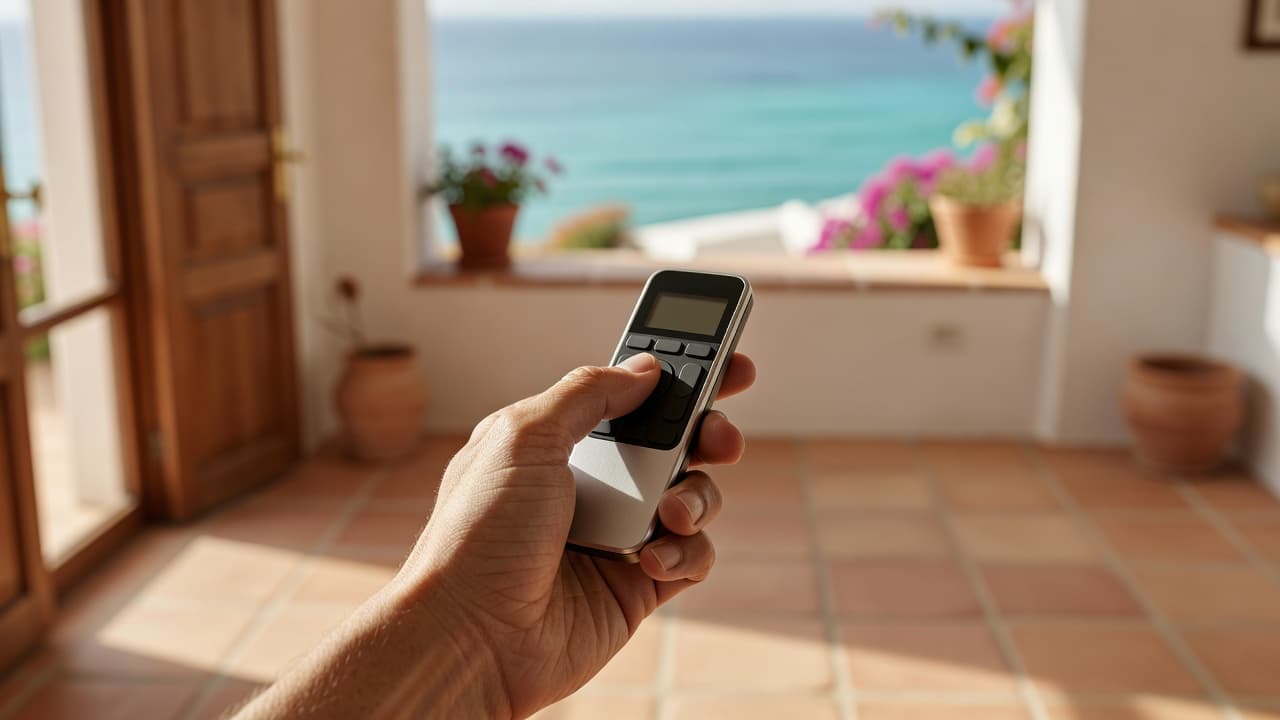
Dead or dying batteries are the single most common cause. A typical remote uses 2–4 batteries, and they drain gradually without obvious warning. You might notice the remote working only when you press buttons repeatedly, or having to be held closer to the unit than usual—both signs the voltage is dropping.
Infrared window blockage comes second. The small dark panel on the front of the remote sends an invisible light signal to the air con unit. Dust, salt spray (especially near the coast or if windows are open during windy weather), or fingerprint oils build up over time. The signal gets weaker or stops entirely.
Signal obstruction at the air conditioning unit is common in holiday homes or flats where furniture has been rearranged. The indoor unit's receiver sits on or inside the unit—if it's now facing a wall, a closed shutter, or thick curtains, the remote can't "see" it.
Infrared receiver failure in the air con system itself is rarer but possible. If the remote is new, the batteries are good, and the window is clean, but still nothing happens, the receiver inside the air conditioning unit may have stopped working. This requires a technician.
If you've confirmed the fault is the air con system, not the remote, you can still control your cooling:
Use the physical control panel on the indoor unit. Most units have a small panel with buttons for power, mode (cool, fan, heat), and temperature. You'll need to operate it manually each time, but it will work. The panel is usually near the bottom or side of the indoor unit.
Adjust the thermostat to a fixed temperature now. Once you've got the system running using the physical buttons, set it to the temperature you want and leave it there. Manual operation is less convenient than remote control, but it buys you time.
Close shutters or curtains during peak sun hours. If it's a hot day on the coast, reducing direct sunlight on windows will help the air con unit work more efficiently while you arrange for the remote to be repaired or replaced.
Do not use the air con excessively while the remote is broken. The physical buttons work fine, but if you're constantly adjusting settings by hand, you're more likely to stress the system. Keep it simple until the professional is involved.
If you open the remote casing to look at the circuit board or try to repair internal components. The risk of breaking it further is high, and replacement remotes are cheap. Stop if you're tempted.
If the air con unit itself isn't responding to physical button presses either. This means the fault is inside the system—possibly the power supply, the control board, or the receiver. Turn off the system at the circuit breaker and call a technician. Do not keep trying to operate it.
If the remote has been dropped in water or exposed to significant moisture. Do not try to use it or dry it yourself. Put it away and use the physical buttons or call for a replacement. Water inside the casing will cause a short circuit.
If both the remote and the physical buttons are unresponsive, and the indoor unit isn't cooling. Cut the power to the air con system using the isolating switch (usually a small button or flip switch near or on the indoor unit), and call an air conditioning technician. There may be an electrical fault.
If you smell burning, see any scorch marks, or the unit makes an unusual noise when you press buttons. Stop immediately, cut the power, and call a technician. These are signs of electrical damage.
When you call an air conditioning technician with a non-responsive remote, they'll start by checking exactly what you've already done—batteries, window cleanliness, sensor obstruction. Most will have a spare remote or a diagnostic tool to test the receiver signal without using a remote at all.
If the remote is the problem, they'll usually recommend replacing it with a compatible model. Original equipment manufacturer (OEM) remotes are more reliable but more expensive; universal remotes are cheaper but may lack advanced features. Your technician will advise based on your system.
If the fault is the infrared receiver inside the air con unit, the technician will replace the receiver module or the main control board, depending on the fault. This is a straightforward job and typically costs between €100 and €250 in parts and labour, though it varies by system and region.
Before leaving, a good technician will confirm that the replacement remote or repaired system works in all modes (cool, heat, fan, dry) and that the buttons respond promptly. If a part has been replaced, they should provide a brief record of the work.
Replace batteries every 12–18 months, even if the remote still seems to work. Proactive replacement avoids the frustration of a dead remote at an awkward moment.
Keep the infrared window clean. Once a month, wipe the dark panel on the front of the remote with a soft, lint-free cloth. This is especially important if you live near the sea, where salt spray accelerates dust buildup.
Avoid dropping the remote or exposing it to moisture. If you're in a bathroom or kitchen, keep the remote away from splashes. If you have young children or pets in the home, store the remote in a drawer when not in use.
Keep the air con unit's receiver sensor clear. Every three months, check that nothing is blocking the sensor window on the indoor unit. Repositioned furniture, new curtains, or overgrown plants should be moved away.
Use the remote from the same room. Infrared remotes have a limited range and don't work through walls or closed doors. If you're controlling the air con from another room consistently, consider discussing alternatives with your technician.
If you've tried the steps above and nothing has worked, or if the air con unit itself isn't responding, it's time to get a technician involved. An air conditioning professional can diagnose the fault in minutes and either replace the remote or repair the receiver without disrupting your cooling. On the Mediterranean coast, especially in summer, it's worth getting it sorted quickly.
Find a qualified air conditioning technician near you