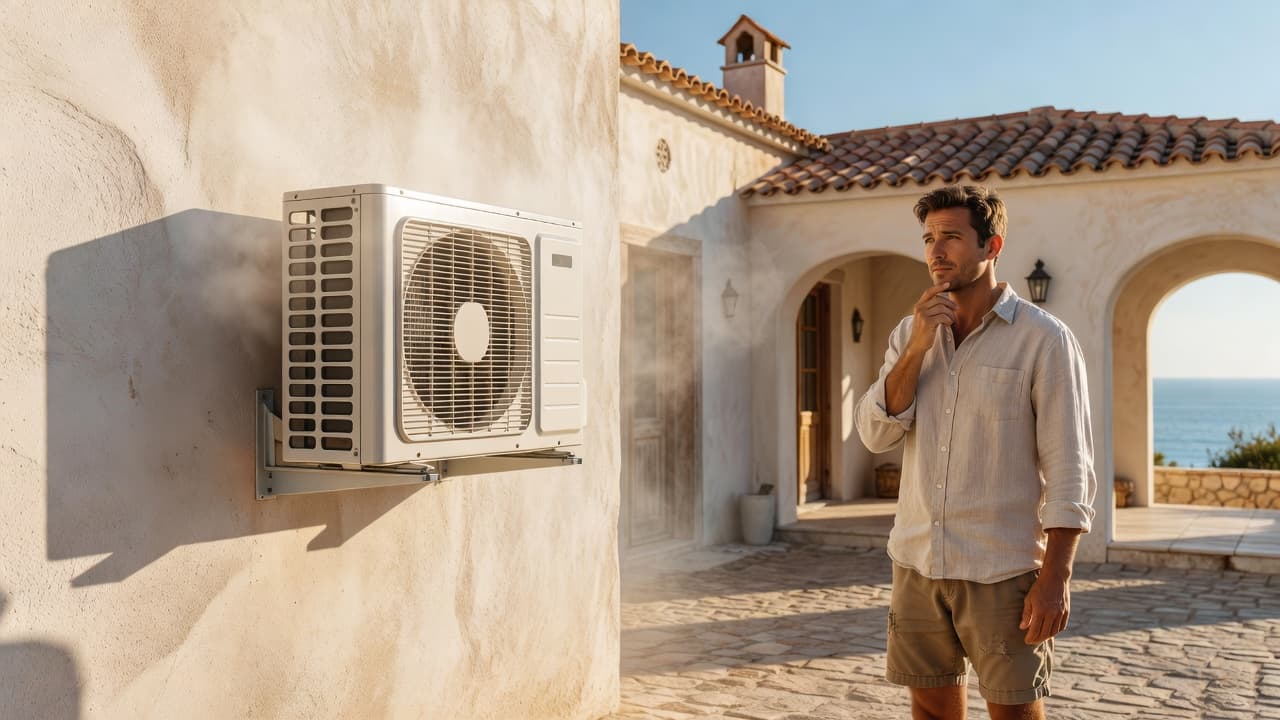
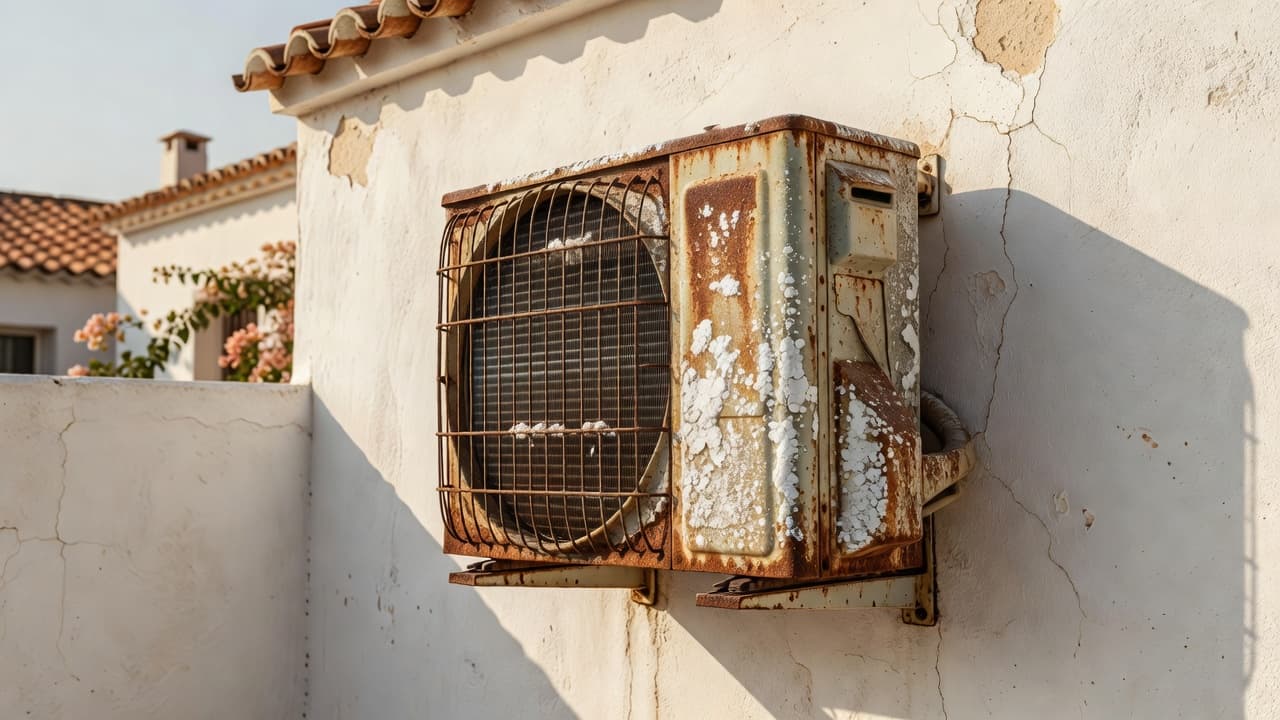
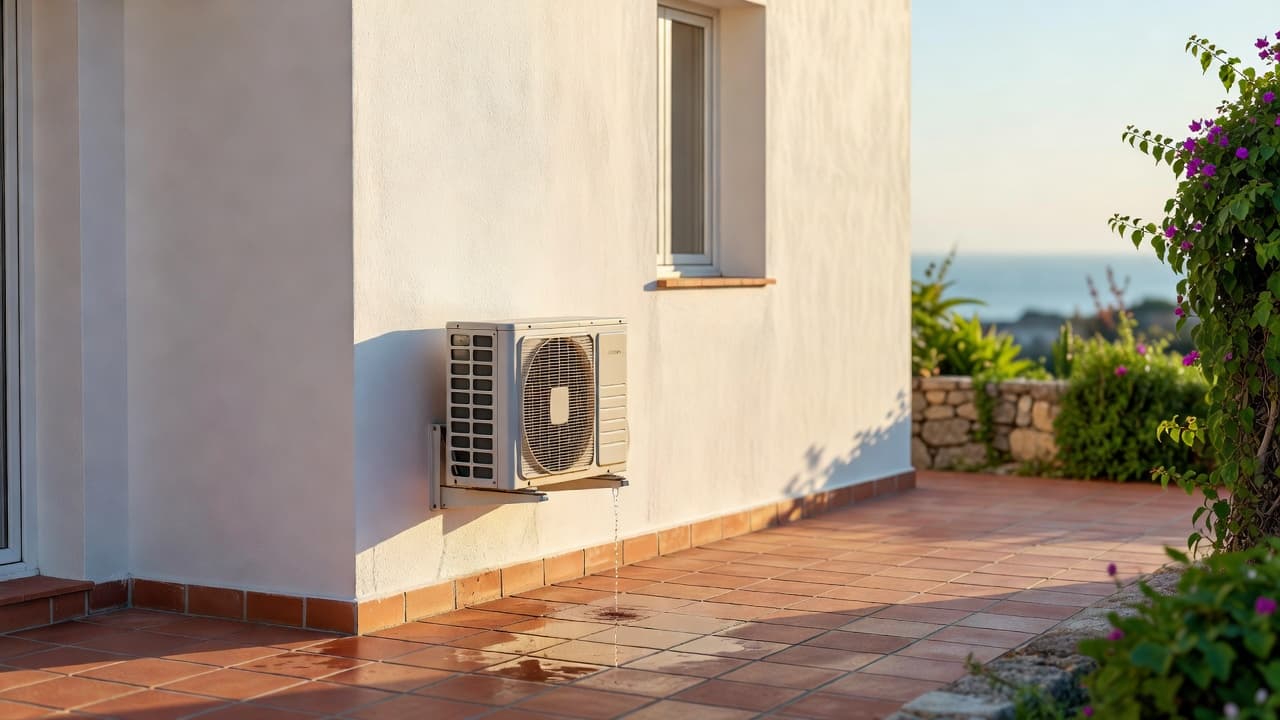
Leaves, dirt, plastic bags and small branches often get caught around the outdoor unit, especially in Mediterranean gardens where gusty winds are common and urbanisations sometimes lack maintenance. If the unit is not making strange noises and has not tripped your electrics, a visual check is safe.
Do this:
- Switch off the unit.
- Stand in front of the outdoor unit and look at the grille (the metal front panel with horizontal slots).
- If you see leaves, twigs or plastic trapped in the grille, you can gently remove them by hand or with a soft brush.
- Do not poke or prod inside the grille. The metal fins behind it are delicate and easily damaged.
Do not do this if:
- The unit is still warm to the touch (wait longer).
- There is a strong smell of burning or chemicals.
- You see water pooling around the unit.
- Any wires or pipes are visibly damaged or disconnected.
If the front grille is simply dusty or covered in a light coating of salt air residue (common on the coast), you can clean it carefully. This is one of the few maintenance tasks that is genuinely safe.
Do this:
- Switch off the unit.
- Wait until it is cool enough to touch (at least 15 minutes after switching off).
- Use a soft brush, dry cloth, or an old soft toothbrush to gently brush away dust and salt deposits from the grille.
- Work horizontally, following the direction of the fins. Do not brush across them or apply pressure.
- You can use a slightly damp cloth if the grime is stubborn, but do not spray water directly at the grille.
Do not do this if:
- You do not have a soft brush (use a hard brush and you risk bending the fins).
- You are using a pressure washer, garden hose or strong spray. Water forced into the unit can damage internal components and cause electrical faults.
- The grille is visibly bent or damaged already.
Air con units must sit exactly level. If the outdoor unit has shifted slightly or is visibly tilted, this can disrupt refrigerant flow and damage internal parts. Checking whether it is secure is a safe visual and gentle tactile inspection.
Do this:
- Switch off the unit.
- Look at the unit from the side. Is it sitting level, or is one corner higher than the other?
- Gently push the side of the unit (not hard, just a gentle press) to check that the mounting bracket is tight. You should feel no movement at all.
- If the unit is level and solid, all is well.
- If the unit is tilted or rocks when you press it, do not attempt to adjust it yourself. Call a technician immediately.
Do not do this if:
- You feel confident to tighten bolts or move the unit. Stop.
- The unit is mounted at height or on a difficult angle. Do not climb or stretch to reach it.
The outdoor unit pulls in air to cool the refrigerant circulating inside. If the grille becomes blocked by leaves, dust or salt residue, the unit has to work harder and harder to do the same job. Efficiency drops, electricity bills rise, and the compressor (the most expensive part) can overheat and fail.
On the Mediterranean coast, salt air deposits on the grille faster than in inland areas. In an urbanisation with trees nearby, autumn leaves can accumulate quickly. This is not a fault — it is just the environment. Gentle cleaning every few months is preventative.
Over time, vibration from the compressor running continuously in summer heat can loosen the bolts holding the outdoor unit to the wall bracket. If the unit tilts, the refrigerant cannot flow correctly through the internal tubes. The compressor can also crack if the mounting becomes too unstable. A wobbly outdoor unit is a serious problem, but it is not a DIY fix.
The outdoor unit naturally produces some condensation. Small drips are normal. However, if you see a steady stream of water or a pool forming beneath the unit, the internal drain line is blocked or the unit has an internal leak. These problems require technical diagnosis.
Hissing, grinding, rattling or buzzing sounds from the outdoor unit usually mean something inside is failing or loose. You cannot fix this yourself, but you can prevent it from getting worse.
- Switch off the unit immediately.
- Do not restart it to see if the noise has gone away.
- Call an air conditioning service professional.
- If the unit has caused an electrical trip (your RCD switch has flipped at the consumer unit), leave it switched off and do not reset the electrics repeatedly. Call the technician.
- Switch off the unit.
- Place a bucket or towel beneath the leak to catch water and prevent it from damaging property below (important in flats and urbanisations where water can affect neighbours).
- Do not try to find or clear the internal drain line yourself. This usually makes the problem worse.
- Call a technician within 24 hours. This is not an emergency if it is only a drip, but it will not resolve on its own.
The outdoor unit becomes warm during operation. The rear panel and the refrigerant pipes can reach 40–50°C on a hot day. This is normal. However, if the unit is too hot to rest your hand on it comfortably after 30 seconds, or if steam is visible, the system may be overcharged with refrigerant or have a circulation fault.
- Switch off the unit.
- Wait for it to cool (30 minutes or more).
- Switch it back on and observe. If the problem recurs within 10 minutes, switch off again and call a technician.
Stop immediately and call a technician if you observe any of these signs:
- Electrical trip: The unit has caused your home's RCD switch or circuit breaker to trip. Do not keep resetting it.
- Refrigerant smell: You smell a sweet, chemical odour near the outdoor unit. This indicates a refrigerant leak, which is harmful and requires specialist equipment to repair.
- Visible damage: Bent fins, cracked casing, loose pipes, frayed wires, or disconnected tubing.
- Unusual sounds: Grinding, metal-on-metal scraping, loud buzzing, or hissing noises that are significantly louder than the normal fan hum.
- Unit is tilted or moving: The mounting is loose or the unit has shifted position.
- Water pooling underneath: Not just a drip, but a steady accumulation or a wet patch that remains hours after the unit is switched off.
- No cool air despite the outdoor unit running and looking normal: This usually means an internal problem with refrigerant, the compressor, or the expansion device.
- The unit feels extremely hot: So hot that you cannot hold your hand on it at all, or steam is visible.
- Burnt smell: An acrid, burnt plastic or electrical odour.
In all these cases:
- Switch off the unit at the wall immediately.
- Do not attempt to restart it to test whether it still has the problem.
- Contact an air conditioning technician as soon as possible. If it is an electrical fault (trip), you may also need an electrician to inspect the fault.
When you call a technician about an outdoor unit problem, it helps to know what to expect. This builds confidence and lets you know whether the visit is progressing normally.
The technician will switch off the unit and perform a visual inspection of the outdoor casing, mounting, pipes and wiring. They will check for signs of damage, leaks or corrosion. They will also ask you when the problem started, what sounds or symptoms you noticed, and whether anything has changed recently (power cuts, strong winds, etc.). Answer these questions accurately — they help the diagnosis.
Depending on the symptoms, the technician may use a pressure gauge to test the refrigerant charge, a multimeter to test electrical continuity, or a thermal imaging camera to check temperature distribution. They may also check the capacitor (a small cylindrical component that helps start the compressor) and inspect the fan motor. These tests take 20–30 minutes. Do not rush them.
Once the fault is identified, the technician will explain what needs to be done, what it will cost, and how long it will take. Some repairs (cleaning blocked drains, replacing a capacitor, tightening loose bolts) take an hour. Others (replacing the compressor, recharging refrigerant) may take longer or require a return visit if parts need to be ordered. Ask for a written estimate if the cost is significant.
After the repair, ask the technician for:
- A receipt showing the work done and the parts replaced (if any).
- A brief explanation of what was wrong and what was fixed.
- Any warranty information on replacement parts (usually 1–2 years for components).
- Advice on maintenance or what to watch for in future.
Keep this documentation safe. It is valuable if you need to make a warranty claim or sell the property later.
Prevention is far cheaper than repair. A few simple habits will reduce the risk of outdoor unit problems.
Keep the area around the outdoor unit clear. Do not allow plants, bins or garden furniture to block the air intake. This ensures the unit can breathe properly.
Check the grille monthly during the cooling season. A 30-second visual inspection to remove any obvious debris takes almost no time and prevents many problems.
Have the unit serviced annually. An annual service visit (usually in spring before the summer demand) costs far less than an emergency repair. The technician will clean internal components, check refrigerant charge, test electrical safety, and catch problems early.
Do not block the outdoor unit with covers in winter. Some people cover the unit to protect it from weather, but this traps moisture and prevents inspection. Leave it uncovered.
Ensure the unit remains level and secure. If you notice it has shifted even slightly during a period of strong winds, contact a technician to check the mounting.
The outdoor unit is the heart of your air con system, but it is not something to fiddle with unless you are genuinely sure of what you are doing. The line between safe inspection and dangerous interference is sharp. When in doubt, it is far cheaper — and far safer — to