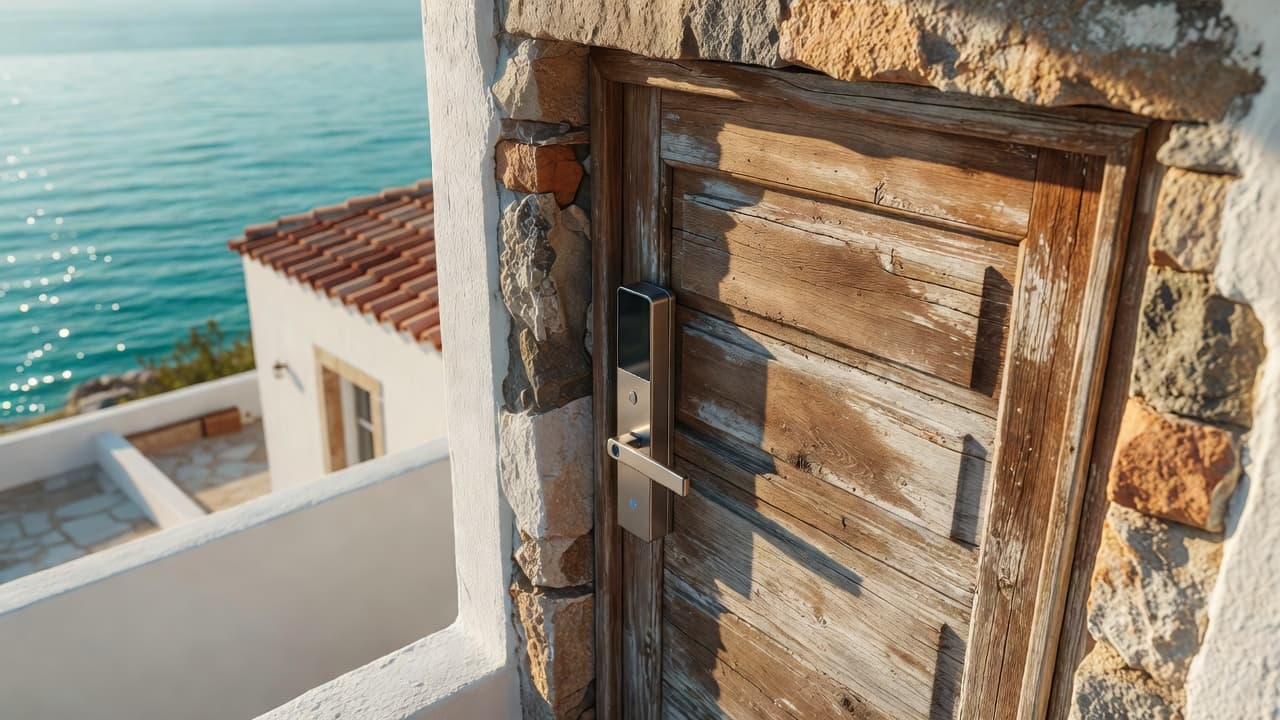
WiFi-enabled locks (the most common) connect to your home WiFi and send data to the cloud. They're convenient but useless if your internet goes down. You can't unlock the door remotely, and sometimes not even receive notifications.
Bluetooth locks work with your phone when you're within 20–30 metres of the door. No internet needed. But from 500 kilometres away, Bluetooth is pointless — you can't access it remotely at all.
Hybrid locks combine Bluetooth, a keypad PIN, and sometimes WiFi. You can use the PIN code or Bluetooth when nearby, and WiFi for remote access when connection is available. This is the most practical for holiday homes with unreliable connections.
Biometric locks (fingerprint or facial recognition) work offline entirely, but they're expensive, require professional installation, and some models still struggle with salt-air corrosion on the Mediterranean coast.
You don't have to mail or hand over physical keys. If you rent the property or have a regular cleaner, send them a PIN code or a temporary Bluetooth access window instead. Fewer lost keys, fewer copies floating around.
PIN codes can be changed instantly. When a guest leaves, revoke their access remotely — or wait for the WiFi to connect and do it then. Either way, no key retrieval needed.
You have a record of who entered when. Many smart locks log access attempts. Useful if something goes missing or you want to know if a tenant arrived on time. Works even if the lock is offline (the log syncs when connection returns).
Less hassle for a family member nearby. If your son lives 40 kilometres away and occasionally needs to check the house, he can unlock the door from his phone — as long as WiFi is on.
Emergency backup if you lose the mechanical key. Many smart locks let you use a PIN or Bluetooth backup even if the original key is missing and the WiFi is down.
You cannot rely on remote access. If the internet is down when a guest arrives or a water leak is discovered, you cannot let anyone in from abroad. You're entirely dependent on that connection, and Mediterranean coastal weather is not kind to it.
Initial cost is high, with ongoing fees. A decent hybrid smart lock costs €300–600 for the hardware. Some models charge subscription fees (€5–20 per month) for cloud storage or extended logs. A mechanical lock costs €50 and has zero running costs.
Professional installation is mandatory. Smart locks must be installed correctly to be secure and weatherproof. DIY installation can void the warranty and create gaps where water seeps in. Budget €150–250 for a locksmith to install it.
Battery failure is a real risk. Most smart locks run on rechargeable or battery cells. If the battery dies and WiFi is also down, you might not get a warning until you're locked out. Backup mechanical keys become critical.
Salt-air corrosion damages many models. Coastal humidity accelerates wear on electronics and metal. Some smart locks are rated IP65 (water-resistant) but not specifically for salt air. Ask the locksmith if the model you're considering has been tested in coastal conditions.
They can be hacked or spoofed. Smart locks are targets for thieves, especially in holiday home areas. A professional can usually bypass them faster than a traditional lock. This is not a reason to avoid them, but it's a reason to install them correctly and use a strong PIN.
Guests must carry a smartphone or learn a PIN. Not everyone is comfortable with a PIN code, and elderly relatives might find the system confusing. A traditional key is more universal.
Option 1: Hybrid lock with strong backup. Choose a model with a keypad PIN, a mechanical key override, and Bluetooth capability. Brands like Yale, Level Lock, and Nuki offer these. Install it on a door where you can physically check it if WiFi dies for weeks.
Option 2: Biometric lock with battery backup. A fingerprint lock that works offline, with mechanical override. No internet needed, no WiFi dependency. More expensive (€800–1,200 plus installation), but genuinely independent.
Option 3: Mechanical lock with a secure hand-over process. The cheapest and most reliable option. A modern euro cylinder lock (bombín europeo) with a secure spare key held by a trusted local contact — a property manager, a neighbour, or a local friend. No technology, no batteries, no outages.
Option 4: Combination of smart and mechanical. Install a smart lock on the front door (which you visit regularly) and keep a traditional lock on the back door. If the smart lock fails, guests or professionals can still access the property via the mechanical route.
Stop and consult a professional locksmith if:
- Your WiFi drops more than once a month and you don't have a local property manager or trusted neighbour to act as backup.
- You cannot afford professional installation or a replacement smart lock if this one fails.
- You visit the property fewer than two or three times a year and have no regular guests or staff needing access.
- The door frame is damp or shows signs of water ingress — moisture will damage the smart lock's electronics regardless of the model.
- You're uncomfortable with a PIN code being shared, and you don't trust Bluetooth-only systems.
In these cases, hire a locksmith to assess the situation. A good locksmith will often recommend a mechanical upgrade rather than a smart solution.
A professional locksmith will start by measuring your door frame and checking the lock alignment. They'll confirm that the smart lock is compatible with your door type — this matters on Mediterranean properties, where doors are often thicker or have non-standard frames.
Next, they'll remove the existing lock (if any) and prepare the hole. For a smart lock, they'll check electrical access for charging or wiring, and test the WiFi signal in that location. If signal is weak, they might suggest repositioning the router or installing a WiFi extender.
Finally, they'll install the lock, test all access methods (key, PIN, app, Bluetooth), and provide you with documentation: the PIN reset code, the app login, the mechanical override key, and the battery replacement schedule. Ask for written instructions. You'll forget how to change the battery if the lock lasts three years without replacement, and written instructions save emergency calls later.
They should also test the backup systems. If the main WiFi fails, can you still unlock with the PIN? Does the Bluetooth work from the street? These tests matter, and a good locksmith will run them with you present.
Set a reminder to check the battery every six months. Even if the lock says "low battery," don't wait. Replace it before the annual holiday when you arrive to find a dead lock.
Test remote access weekly if you're away. Log into the app, simulate a guest access window, confirm it works. If the connection is unreliable, you'll discover it in testing, not in an emergency.
Keep the mechanical override key in a secure separate location. Not in the drawer next to the lock. In a key safe with a friend, or a property manager, or locked in a cupboard elsewhere in the house.
Document the PIN code. Write it down in a place you'll find it if the app fails — a notebook, a password manager, or a note to a trusted local contact. If you lose the PIN and the WiFi is down, you're locked out.
Schedule annual checks. Ask a local handyman or locksmith to inspect the lock, test the battery, and confirm the door is still weatherproof. Salt air accelerates wear; you want to catch corrosion early.
Smart locks are convenient for holiday homes, but they're not a substitute for reliable internet. If your WiFi drops regularly, choose a hybrid model with strong backup options — a PIN code, a mechanical key, and Bluetooth access. Expect to pay €400–800 for hardware and installation combined.
If your connection is truly chaotic, a traditional lock with a property manager or local contact holding the spare key might actually be more reliable and cheaper. There's no shame in that choice.
Before you buy, talk to a local locksmith. They'll know which models survive coastal conditions, which ones fail fastest in your area, and whether a smart lock makes sense for your situation. A good locksmith will sometimes tell you not to install one — and that advice is worth listening to.
If you'd like to discuss smart lock options for your specific property, get quotes from local locksmiths who understand Mediterranean coastal conditions. They'll assess your WiFi, your usage pattern, and your backup options in person.